

If you've ever held a tiny, precise metal component in a car's dashboard, a smartphone's inner frame, or a medical device's actuator, chances are it was made using progressive dies. As a progressive dies supplier, I've spent years walking customers through the ins and outs of these tools, and one question comes up again and again: What's the actual role of the die holder? It's easy to think progressive dies are just the sharp, forming parts that shape metal, but the die holder is the unsung workhorse that makes every step of the process possible. Let's break this down, no jargon overload-just the real, on-the-floor details that matter when you're designing or sourcing parts.
First, let's ground this in what progressive dies actually are, because terms can get mixed up fast. You might hear "progressive stamping die", "progressive die", "progressive sheet metal die", and "progressive forming die" tossed around interchangeably, and while they're all closely related, they share a core system: a sequence of operations done on a single strip of metal as it feeds through a press. The die holder is the backbone that every single one of these operations relies on-without it, the sharp punches, blanking blades, and forming dies would just be loose pieces of metal sitting on a table, not a functional tool that runs 24/7.
To get concrete, think of a progressive die as a multi-act play. Each "scene" is a station: first, the metal strip is pierced with small holes, then shaped into a curve, then trimmed to the right size, then punched with a logo, before finally being ejected as a finished part. The die holder is the stage where all these scenes happen. It's not just a plate to bolt parts to-it's a precision-engineered assembly that keeps every single tool aligned, positioned correctly, and held steady under tons of pressure. Let's dive into the key roles that make the die holder non-negotiable for consistent, high-volume stamping.
The first big job is alignment and precision retention. Progressive dies operate with tolerances that are often measured in thousandths of an inch-for a smartphone battery connector, for example, a misalignment of 0.002 inches can make the part fail to fit or function. The die holder's main structure is made from hardened tool steel or cast iron, materials chosen for their rigidity and resistance to wear over millions of cycles. It has machined slots, holes, and pilot holes that are milled to exact dimensions, so every punch, die insert, and guide pin locks into place perfectly. When we build a custom progressive die for a customer, we spend 20% of the total build time just machining and fitting the die holder, because even a 0.001-inch shift between two stations can scrap thousands of parts. I see this all the time: a customer might try to save money by going with a cheaper die holder that uses generic, off-the-shelf components, and within a few runs, they're dealing with misaligned holes, uneven burrs, or parts that don't meet specs. The die holder isn't something you cut corners on-it's the foundation that keeps all the other parts working as intended.
Next, the die holder handles load distribution and structural integrity. Progressive stamping presses can exert hundreds of tons of force, depending on the part. That force doesn't just go into shaping the metal-it pushes directly on the die inserts and the holder itself. A high-quality die holder distributes this load evenly across its entire surface, instead of concentrating it in small spots that would wear out or crack quickly. For example, when a blanking station punches out a small part from the metal strip, the blanking blade exerts a sharp, concentrated force on the die holder's cavity. A poorly designed holder would have stress points here that crack after a few thousand cycles, but our die holders are engineered with thicker material in high-load areas, and sometimes we add support ribs or hard chrome plating to prevent that. We've seen dies run with a faulty die holder last only a few weeks, while a properly built holder can last 10 years or more, even when running 24/7 for automotive suppliers with high volume demands.
Then there's the role of guiding and feeding the metal strip, which ties directly to the die holder's design. The metal strip moves through the progressive die station by station, and it needs to be positioned accurately every time. The die holder incorporates strip guides, pilot pins, and feed blocks that work together to keep the strip from shifting side to side or forward too far. These components are machined directly into the holder or mounted precisely to it, so they move in sync with the press's stroke. If the die holder's guide slots are worn or misaligned, the strip will wander through the stations, leading to parts that are off-size or have uneven cuts. I had a customer a few months back who was having trouble with parts that had inconsistent hole placement-after inspecting the die, we found that the die holder's side guide rails had worn down from repeated strip friction, letting the strip shift slightly left with each run. Replacing the worn guide inserts (mounted to the holder) fixed the problem immediately, and they were able to get back to running full production without downtime. That's the die holder working as a system, not just a base.
Another critical role is flexibility for customization and maintenance. When a customer needs a new part design, we don't have to build an entire new die from scratch-we can often modify the die holder to fit new inserts. For example, if a medical device manufacturer has a small change to a part's forming shape, we can machine new forming die inserts that fit into the existing slots of the die holder, instead of fabricating a whole new holder. This saves customers time and money, which is a huge plus in an industry where lead times matter. Also, when maintenance is needed-like replacing a worn punch or die insert-the die holder's modular design makes it easy to swap parts out, instead of having to take apart the entire die. That means less downtime for customers, which translates to higher productivity. As a supplier, we emphasize this modularity in our progressive stamping die offerings, because we know that being able to adapt and maintain dies quickly is just as important as initial quality.
Wait, let's clarify some terms here, because it's easy to mix up "progressive die" and related terms. A progressive die is a type of tool, and the die holder is a key component of that tool. When people search for "progressive sheet metal die" or "progressive forming die", they're looking at the entire tool, but the die holder is the part that unites all the functions of that tool. For example, a progressive forming die relies on its die holder to keep all the forming punches and dies aligned, so the metal is shaped correctly in each step, without wrinkling or warping. A progressive press tool, on the other hand, is the complete assembly that includes the die holder, the press, and all the operating components, but again, the holder is the core that connects everything to the press. I always tell customers: the die holder is like the spine of the progressive die-remove it, and the whole thing collapses.
I also want to talk about real-world challenges that come with die holder design, because that's what makes this work interesting. For materials that are hard to stamp, like high-strength steel or thin, flexible aluminum, the die holder has to be even more precise. Thin aluminum strips can bend or twist if the holder's guide slots aren't perfectly smooth, so we add precision ground surfaces and self-lubricating inserts to the holder's guide rails. For high-strength steel, the holder has to be extra rigid to handle the higher force, so we use forged tool steel instead of cast iron, because forged material is less prone to internal defects that can cause cracking under pressure. We test every die holder we build using coordinate measuring machines (CMMs) to ensure all the alignment and tolerance specs are met, because even a small flaw here can lead to major production issues for our customers.
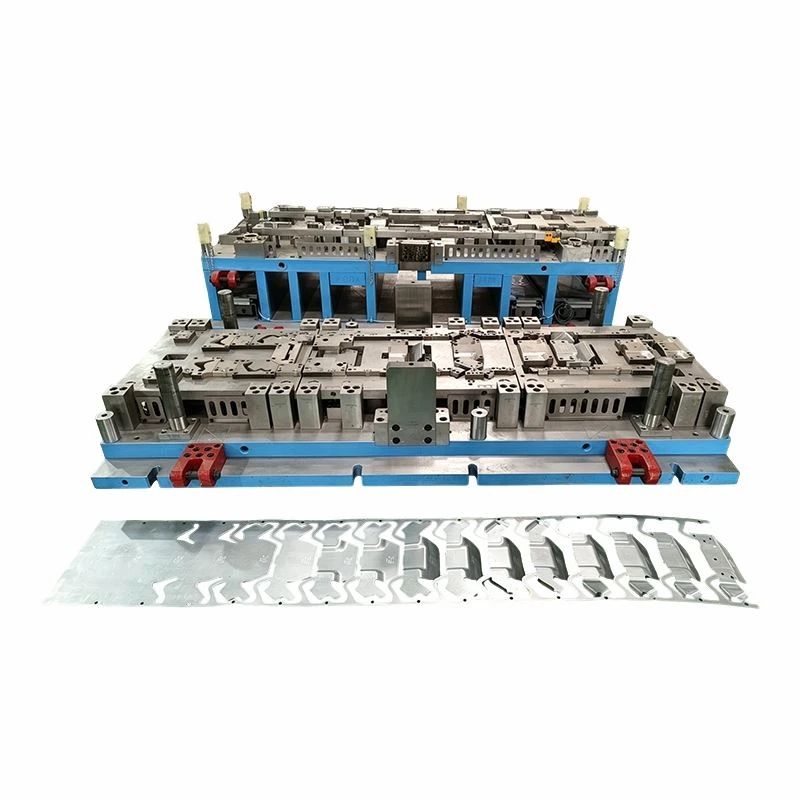
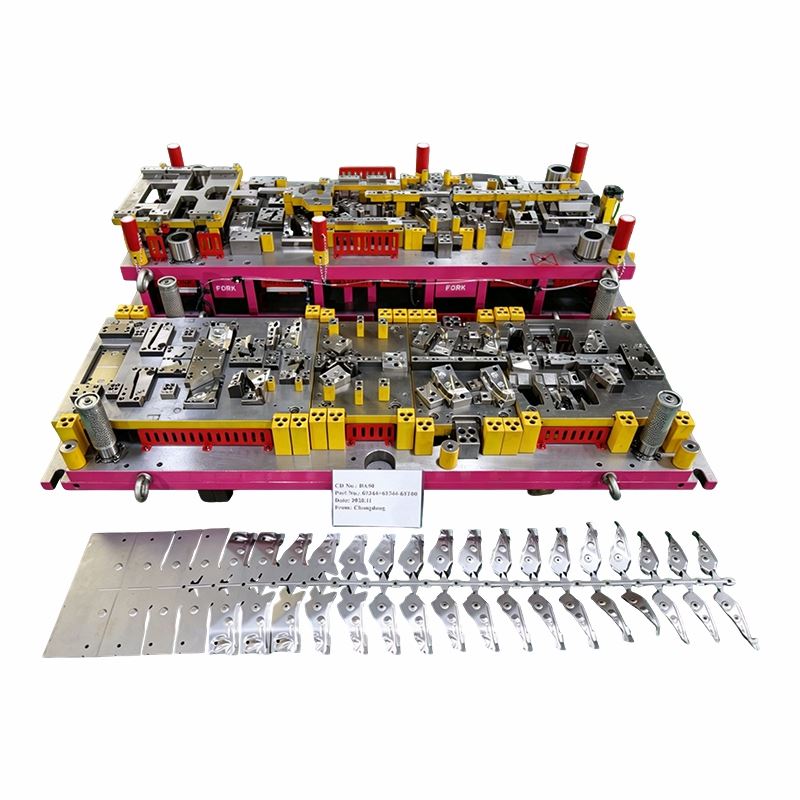
Let's wrap this up with why it matters for you, the person sourcing progressive dies. A lot of suppliers will cut corners on die holders to lower their price, but that's a false economy. A cheap die holder might save you a few thousand dollars upfront, but it will lead to downtime, scrap parts, and expensive repairs down the line. As a progressive dies supplier, we prioritize die holder quality because we want our customers' lines to run smoothly, day in and day out. Whether you're needing a progressive stamping die for automotive components, a progressive forming die for medical parts, or any other custom progressive tool, the die holder is a critical part that deserves the same attention as the punches and dies.
If you're currently working on a new part design, or you're experiencing issues with your existing progressive dies, I'd be happy to walk you through the details of how our die holders can meet your needs. We build custom progressive dies tailored to your exact specifications, with die holders engineered for precision, durability, and easy maintenance. Don't let the unsung workhorse of your die go overlooked-reach out to us to discuss your project, and we'll help you get a tool that delivers consistent, high-quality parts for years.
References
- Tool and Manufacturing Engineers Handbook (TMEM), Volume II: Forming, Society of Manufacturing Engineers, 2017.
- Modern Metal Stamping Technology: Design, Materials, and Processes, Elsevier, 2020.
- "Progressive Die Design Best Practices", Stamping Journal, Vol. 45, No. 3, 2021, pp. 18-22.