

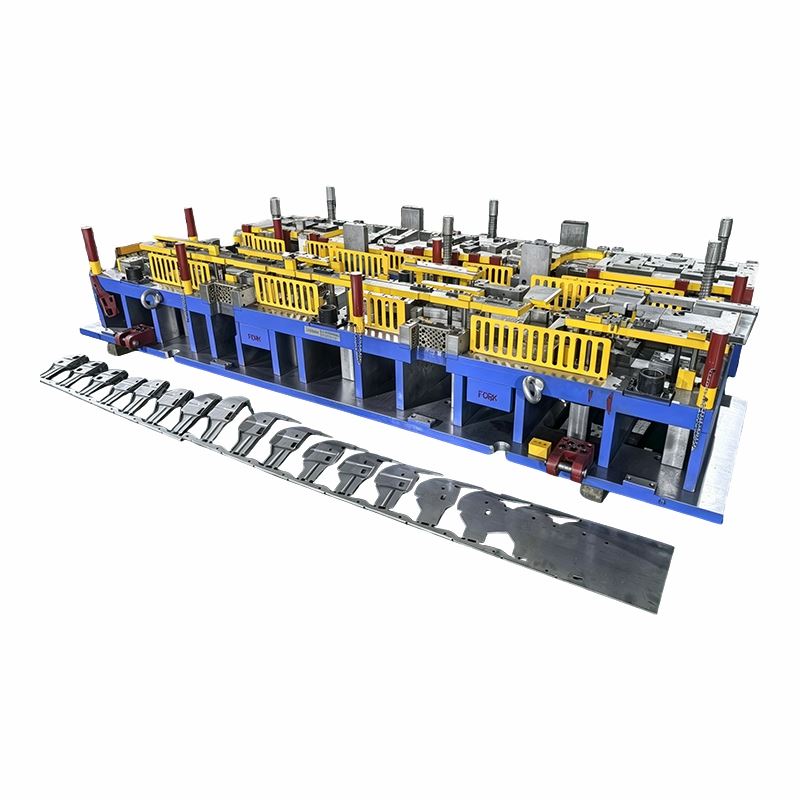
Development of a Progressive Stamping Tool starts with a readable process proposal, not only a final assembly model. The strip concept should show feed direction, pitch, pilot locations, carrier width, scrap bridges, and the station where each feature is made. A progressive tool drawing is then prepared with die height, shut-height reference, plate stack, sensors, and maintenance access. For a sheet metal progressive tool, the drawing package should also identify the datum strategy used to inspect the strip and finished part. Some project files group this work under progressive tool sheet metal; in practice, early review of hole position and bend sequence often prevents expensive changes after steel has been cut.
The main progressive tool components include punches, die inserts, stripper plates, pilots, guide elements, lifters, springs, and cutoff parts. Their arrangement should support quick adjustment and replacement without dismantling unrelated areas. The choice between a compound tool and progressive tool depends on part complexity, output requirement, feed method, and whether forming must be spread over several strokes. Die steel, hardness, surface treatment, and standard components are selected against wear risk. MISUMI is commonly specified, while PUNCH INDUSTRY, SANKYO OILLESS, Danly, Dayton, or FIBRO may be considered when dimensions and customer standards allow.
The Progressive Stamping Tool can be applied to brackets, clips, terminals, covers, reinforcement pieces, and other repeat parts made from coil. Each application changes the engineering focus. A clip needs controlled spring behavior; a terminal needs pitch and burr control; a bracket often needs carrier stability and repeatable mounting holes. Thin visible parts require protection from tool marks, while high-strength sheet may need more forming stages and springback compensation. Stable dropping off at cutoff is planned together with scrap routing so the finished part is not damaged by the chute or by accumulated waste.
Before quotation, buyers should share the 2D drawing, 3D drawing, die technical standards, and press specification. Expected annual demand, material grade, coating, tolerance targets, and sample-report format help define the tool concept. Changdong can review whether the Progressive Stamping Tool should use a compact strip, added idle stations, removable inserts, or extra sensing based on the actual project rather than a generic template.
Hot Tags: progressive stamping tool, China progressive stamping tool manufacturers, suppliers, factory


