

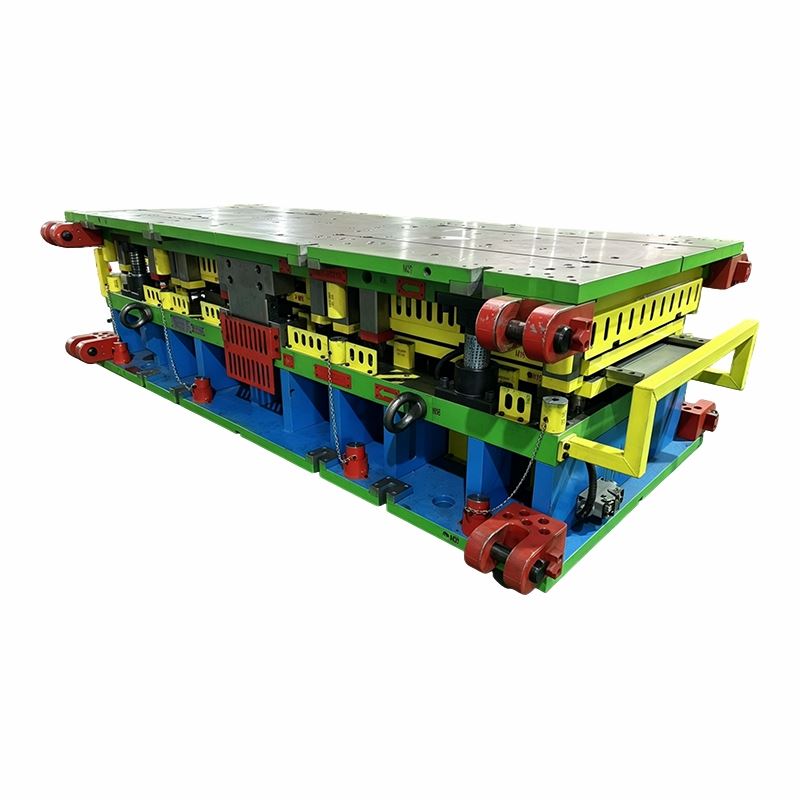
Product Parameters
|
Item |
Specification |
|
Product Name |
Progressive Die for Terminals |
|
Part Material |
VW 50065-CR2-GI40/40-U |
|
Material Thickness |
1.0 mm |
|
Die Set Size |
3660L x 1450W mm |
|
Bottom Plate Size |
3660L x 1450W x 800H mm |
The Progressive Forming Die sequence should be built from the functional datums of the terminal, not from a standard station pattern. A progressive die drawing identifies feed direction, pitch, carrier bridges, pilots, blank development, and the station assigned to every feature. If the part needs cup or channel geometry, a progressive drawing die approach may spread deformation across several stations. A progressive piercing die station is placed where the strip is sufficiently stable to hold hole position, while a progressive blanking die station should leave enough carrier for the remaining forms and a clean final cutoff.
Progressive forming tooling must control the relationship between pierced features, bend lines, and contact surfaces. The 1.0 mm coated material may show springback or surface pickup depending on geometry and lubrication. Forming radii, pressure-pad timing, and restrike stations are adjusted to hold profile without marking functional areas. The Progressive Forming Die should be checked for burr height and direction, trimming line, flatness, bend angle, hole position, and tool marks. Small terminal features also require stable pilots and close attention to punch wear because minor clearance changes can affect assembly fit.
CAE simulation may be applied to uncertain forming zones before machining, but the trial strip remains the final evidence. Each station sample is labeled so dimensional change can be traced to a specific operation. During Progressive Forming Die tryout, strip lift, pilot entry, sensor timing, and final dropping off are observed at low speed. The die-set and bottom-plate dimensions must be matched with the actual bolster, shut height, feed line, stroke, and die clamping arrangement. Scrap must clear the press without contacting finished terminals.
For a tooling review, provide the 2D drawing, 3D drawing, die technical standards, and press specification. Please also identify material coating, plating or contact-surface restrictions, annual volume, tolerance targets, and inspection method. These inputs allow the station plan and press interface to be evaluated without inventing missing production data.
Hot Tags: progressive forming die, China progressive forming die manufacturers, suppliers, factory


