

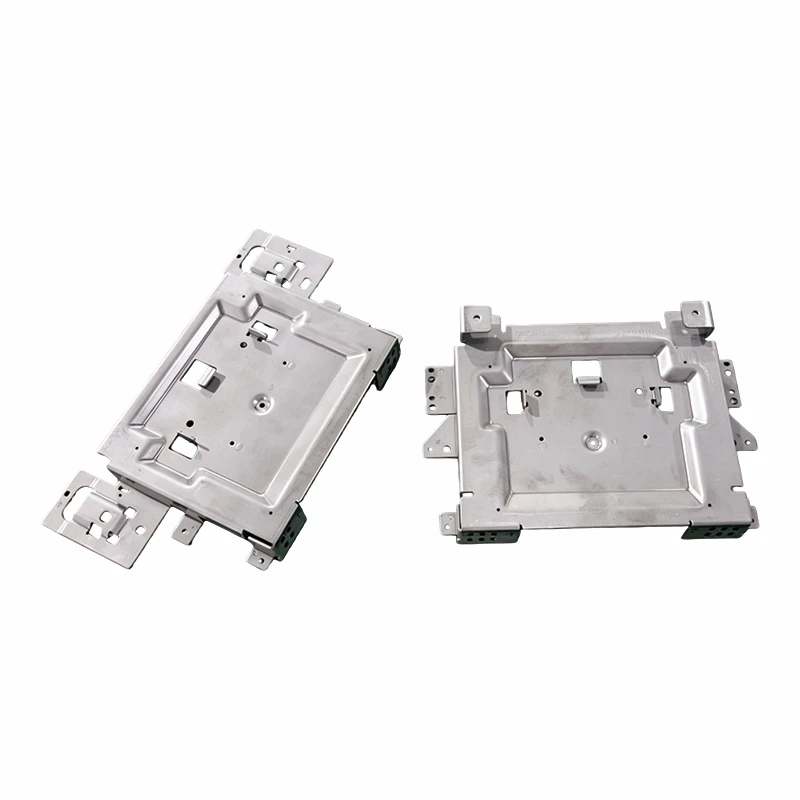
Product Parameters
|
Item |
Specification |
|
Product Name |
Appliance Panels |
|
Part Material |
SPHC / SPCC |
|
Material Thickness |
2.0 mm |
|
Blank Size / Pitch |
2.0T x 457W x 273P |
|
Tooling / Process |
6 single-operation dies |
|
Output |
1 out per stroke |
A 2.0 mm panel can serve as a base, reinforcement, equipment support, or internal structural plate. the component in SPHC or SPCC offer useful stiffness, but material grade and surface condition should be confirmed before tooling because hot-rolled and cold-rolled sheet behave differently in forming and finishing. The drawing should identify visible zones, weld locations, and assembly faces. If bracket sheet metal features are formed directly into the panel, their height and angle should be controlled relative to the main datum surface. Flatness can be affected by piercing patterns, flange direction, and residual stress.
Separate dies can make a heavy panel easier to develop than a single complex tool. Each stage may be tested and corrected without disturbing unrelated features. the component should be located consistently between operations, particularly when multiple holes or embossments must match an appliance frame. Part weight and manual handling also influence nest design and operator safety. During tryout, the team should review springback, corner condition, and whether the panel rocks on its assembly face. These practical factors affect sheet metal parts costing because extra correction, handling, or inspection can add more cost than the basic cutting operation.
Buyers should share drawings, material option, production volume, surface treatment, and tolerance priorities. For the component, it is helpful to provide mating-part data and indicate whether welding, riveting, or threaded fasteners are used. Changdong can review the die sequence and suggest sample inspection points based on the component function. Customers comparing an appliance panels manufacturer in china or an appliance panels oem supplier can also specify packaging and cosmetic standards. This allows quotation and process planning to reflect both manufacturing and final assembly expectations.
For appliance panels for industrial assembly, the acceptance method should reproduce the normal mounting condition whenever flatness is critical. A rigid 2.0 mm panel may still show local stress around pierced or embossed features, and that behavior is easier to judge on the correct support points.
Company Qualification for Appliance Panel Projects
Appliance panel projects benefit from documented quality systems and verified tooling capability. Changdong can display ISO 9001, High-Tech Enterprise recognition, and a patent for a multi-station integrated mold device in this section. These documents are relevant because 2.0 mm appliance panels often combine holes, embossments, flanges, and flat mounting faces in one part family. The quality certificate supports process control and inspection consistency, while the high-tech qualification and patent material show ongoing development in die structure and staged sheet-metal processing. For buyers reviewing an appliance panel supplier, this evidence can help confirm that engineering review, trial adjustment, material control, and production reporting are handled as part of a controlled manufacturing process rather than as isolated stamping operations.


Hot Tags: appliance metal panels, China appliance metal panels manufacturers, suppliers, factory


