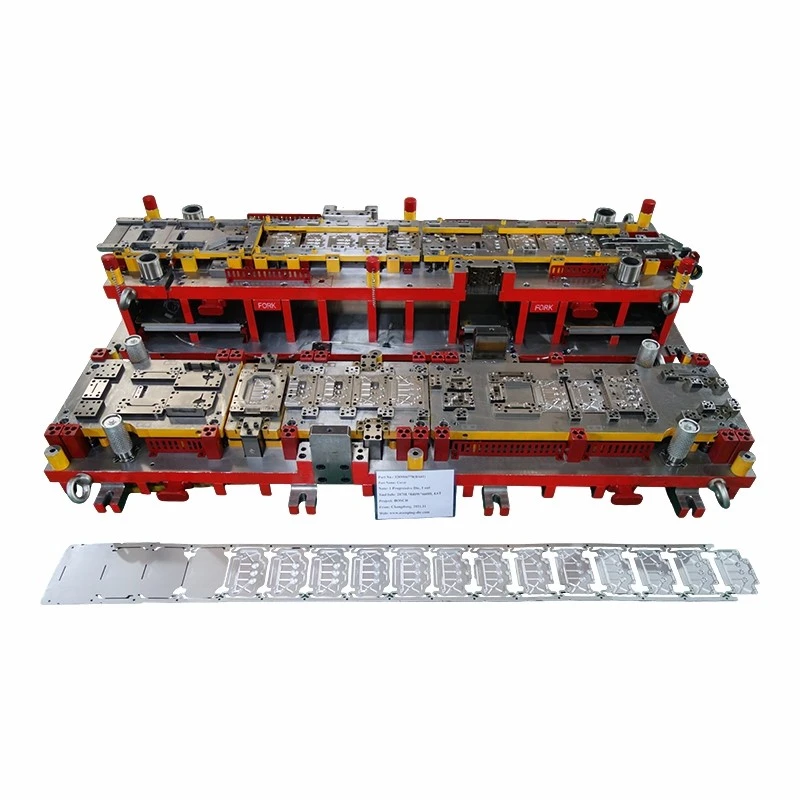
Stamping dies are essential tools in metal forming; they apply external force via a press to induce plastic deformation in sheet metal, thereby producing parts with the required shapes and dimensions. Widely used in industries such as automotive manufacturing, electronics, and home appliances, these dies are particularly suited for the mass production of complex metal components. Their core value lies in enhancing production efficiency through standardized design while ensuring dimensional consistency via precision machining.
Technical Principles and Structural Design:
These multifunctional stamping dies utilize a multi-stage progressive die structure, integrating processes such as flanging, bending, trimming, deep drawing, and finishing into a single tool assembly. The process involves progressively stamping the sheet metal along a predetermined path; each station performs a specific deformation step, ultimately yielding a finished part through a continuous stamping sequence. This design eliminates the need for multiple clamping operations required by traditional single-stage dies, thereby significantly shortening production cycles. Precision blanking is achieved through a multi-station layout that optimizes the clearance between the punch and die (with tolerances controlled within 0.1 mm), ensuring smooth edges and high dimensional accuracy. Tin plating is applied to the surface to enhance corrosion resistance, reduce frictional resistance during stamping, and extend the die's service life.
Usage and Application Scenarios:
This die solution supports the forming of sheet metal and is suitable for producing stamped hardware components with thicknesses ranging from 0.5 mm to 5 mm. Operation requires adjusting the press speed (typically 50–300 strokes per minute) and pressure parameters (tonnage selected based on part size) according to material properties to prevent cracking or springback during plastic deformation. The die offers flexible adaptability, allowing for the rapid replacement of station components; by adjusting punch shapes and die dimensions, a single die assembly can produce various similar parts. For instance, in the manufacture of automotive body accessories, the same die set can produce brackets and clips of different specifications simply by swapping out station modules. Typical lead times are 8–15 days for production and 4–7 days for prototyping, depending on part complexity and order volume.
Technical Highlights and Performance:
Compared to traditional single-stage tooling, multi-stage progressive dies boost production efficiency by three to five times through process integration. For instance, manufacturing an automotive door lock bracket-a task that traditionally requires five sets of dies and ten clamping operations-can be completed using just one die set and a single clamping operation. Regarding precision, the multi-station stamping process employs dynamic compensation technology to limit dimensional variation to within ±0.05 mm, thereby meeting the automotive industry's stringent requirements for component consistency. The modular design also reduces maintenance costs; if a specific station experiences wear, only the corresponding module needs to be replaced rather than scrapping the entire tool, effectively extending the die's service life. Furthermore, a tin-plated surface finish ensures the die retains its surface quality even after 100,000 consecutive stamping cycles, reducing the frequency of downtime required for cleaning.