

In the realm of metal stamping, die clearance stands as a critical factor that significantly influences the quality of the final product. As a seasoned metal stamping die supplier, I've witnessed firsthand how the right or wrong die clearance can make or break a stamping project. In this blog post, I'll delve into the impact of die clearance on metal stamping quality, exploring its various aspects and providing insights for optimal results.
Understanding Die Clearance
Die clearance refers to the space between the punch and the die in a metal stamping operation. It is typically measured as the difference between the punch diameter and the die opening diameter. This clearance is crucial because it determines how the metal behaves during the stamping process. A proper die clearance ensures smooth and efficient stamping, while an improper one can lead to a host of issues.
Impact on Cut Edge Quality
One of the most noticeable impacts of die clearance is on the cut edge quality of the stamped part. When the die clearance is too small, the metal is subjected to excessive shearing forces, resulting in a rough and burr - ridden cut edge. The metal may also experience extrusion and tearing, which can lead to inconsistent edge dimensions and poor surface finish. On the other hand, if the die clearance is too large, the metal will deform excessively before shearing, causing the cut edge to have a large radius and a significant amount of rollover. This can compromise the dimensional accuracy of the part and make it less suitable for applications where precision is required.
For example, in the production of Hardware Stamping Die, a precise cut edge is essential for the proper functioning of the hardware components. A well - controlled die clearance ensures that the edges are clean, smooth, and free from burrs, which is crucial for the assembly and performance of the final product.
Influence on Part Dimensional Accuracy
Die clearance also plays a vital role in determining the dimensional accuracy of the stamped part. An incorrect die clearance can cause the part to expand or contract during the stamping process, leading to deviations from the desired dimensions. If the clearance is too small, the part may be compressed, resulting in a smaller size than specified. Conversely, a large clearance can cause the part to stretch, leading to an oversized part.
In the case of Transfer Press Tool applications, where multiple operations are performed on a single part, maintaining accurate dimensions is of utmost importance. Any deviation in dimensions can lead to misalignment and poor fit during subsequent assembly processes, potentially rendering the entire part useless.
Effects on Tool Life
The die clearance has a direct impact on the life of the stamping tools. When the clearance is not properly set, the tools are subjected to increased wear and stress. A small clearance can cause excessive friction and heat generation between the punch and the die, leading to rapid wear of the cutting edges. This can result in frequent tool sharpening or replacement, increasing production costs and downtime.
A large clearance, on the other hand, can cause the punch to deflect during the stamping process, leading to uneven loading on the tool. This can cause the tool to break or crack prematurely. For instance, in Stamping Mould manufacturing, proper die clearance is essential to ensure the longevity of the moulds, reducing the overall cost of production.
Impact on Material Flow
Proper die clearance is also crucial for controlling the material flow during stamping. When the clearance is well - balanced, the metal flows smoothly around the punch and into the die cavity, resulting in a uniform and defect - free part. However, an improper clearance can disrupt the material flow, leading to issues such as wrinkling, cracking, or incomplete filling of the die cavity.
In Punch Die operations, where the material is punched out from a sheet, a correct die clearance ensures that the material is sheared cleanly and the punched part has a uniform shape. If the clearance is wrong, the material may not be sheared completely, or it may be deformed in an unpredictable manner, leading to a sub - standard product.
Factors Affecting Die Clearance Selection
Selecting the appropriate die clearance is not a one - size - fits - all process. Several factors need to be considered, including the type of metal being stamped, the thickness of the metal, and the stamping operation being performed.
- Type of Metal: Different metals have different mechanical properties, such as hardness, ductility, and toughness. For example, soft metals like aluminum require a larger die clearance compared to harder metals like steel. This is because soft metals are more ductile and tend to deform more easily during stamping, so a larger clearance is needed to prevent excessive deformation.
- Metal Thickness: The thickness of the metal is another critical factor. Generally, as the metal thickness increases, the die clearance also needs to increase. This is because thicker metals require more space for the material to flow and be sheared properly.
- Stamping Operation: The type of stamping operation, such as blanking, piercing, or bending, also affects the die clearance selection. For example, blanking operations usually require a smaller clearance compared to piercing operations to ensure a clean cut.
Optimizing Die Clearance for Progressive Stamping Dies
In Progressive Stamping Die applications, where multiple stamping operations are carried out in a sequence, optimizing die clearance becomes even more challenging. Each operation may require a different die clearance depending on the specific task, such as cutting, forming, or bending.
To achieve optimal results in progressive stamping, it is essential to carefully analyze the material flow and the forces acting on the part at each stage of the process. Computer - aided design (CAD) and finite element analysis (FEA) tools can be used to simulate the stamping process and determine the optimal die clearance for each operation. This can help in reducing trial - and - error in the tooling design process and improving the overall efficiency and quality of the stamping operation.

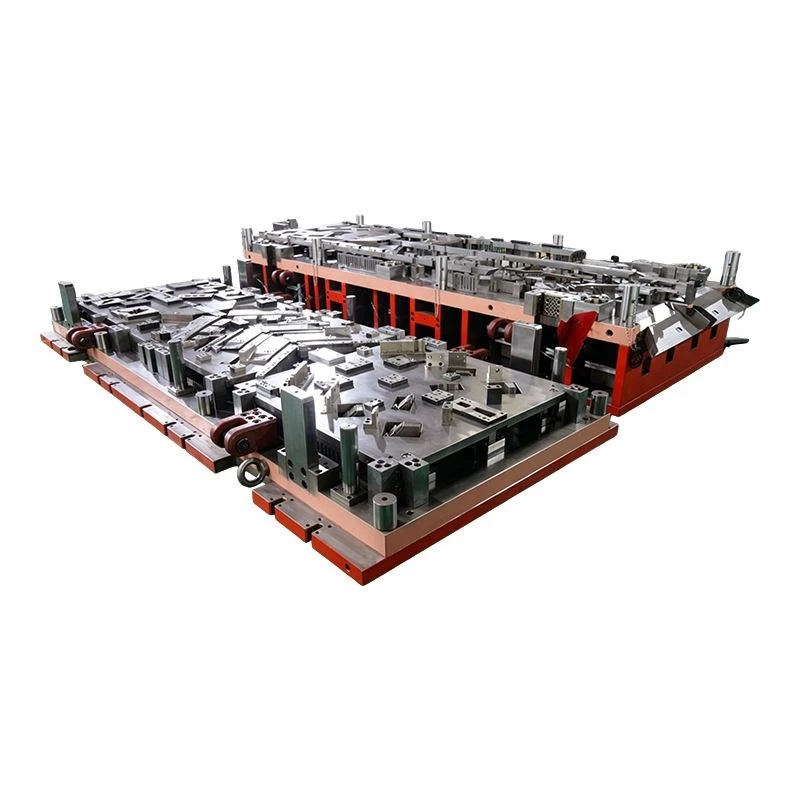
Contact for Quality Metal Stamping Dies
If you're looking for high - quality metal stamping dies that are designed with precision to ensure the right die clearance and superior stamping quality, don't hesitate to reach out to us. We have the expertise and experience to provide customized solutions that meet your specific requirements. Whether you need a Hardware Stamping Die, a Transfer Press Tool, a Stamping Mould, a Punch Die or a Progressive Stamping Die, we can deliver. Contact our sales team today to discuss your project and start the journey towards high - quality metal stamping.
References
- Dieter, G. E. (1988). Engineering Metallurgy: Principles and Applications. McGraw - Hill.
- Kalpakjian, S., & Schmid, S. R. (2008). Manufacturing Engineering and Technology. Pearson Prentice Hall.
- Thippeswamy, T. S. (2012). Metal Forming Technology. Excel Books.