

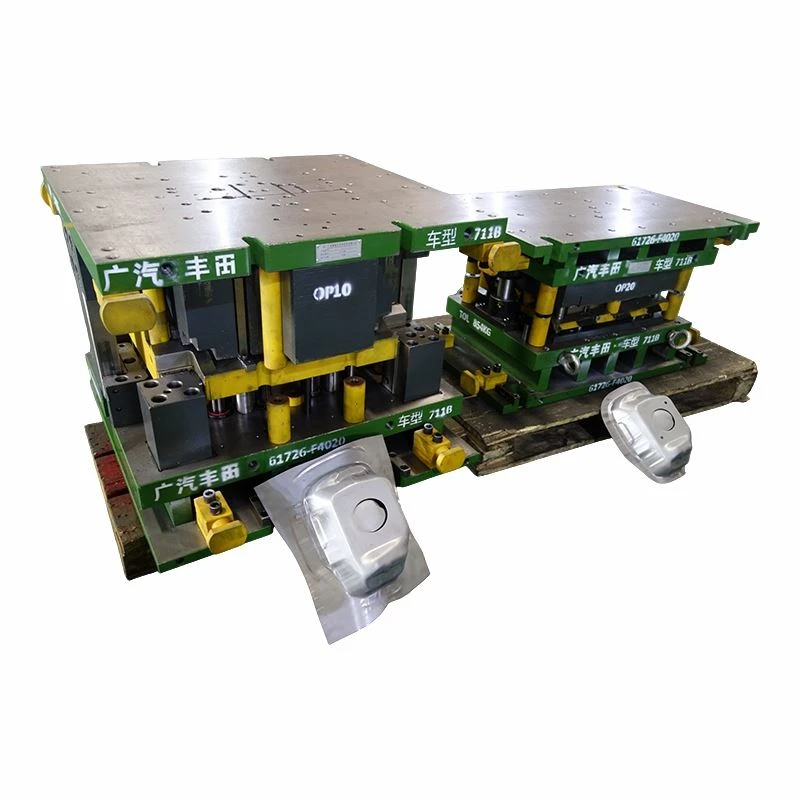
Punch Die for GAC Toyota Automotive Project
This Punch Die was built for a GAC Toyota automotive project. The 200T press shown here is part of the actual trial environment used at Changdong.
For this type of tooling, we do not judge the result only by whether the press can complete a stroke. We look at the stamped edge, burr condition, hole position, stripping and what happens to the slug after cutting.
If something changes during tryout, the die stays close to the people who designed, machined and fitted it. That short feedback loop is one of the practical advantages of building and trying the tool in the same factory.

Product Parameters
|
Item |
Specification |
|
Product Name |
Punch Die |
|
Project |
GAC Toyota |
|
Application |
Automotive Stamping Tooling |
|
Press Reference |
200T Press Machine |
|
Tooling Support |
Design / Machining / Fitting / Tryout / Sample Correction |
What We Actually Check on the First Trial Parts
The first trial parts usually tell us more than a long checklist.
If the burr is already heavy on one edge, we look at the corresponding cutting section. If the burr is clean but the hole position is wrong, changing clearance will not solve the problem. If the surface shows a small dent after several strokes, we check whether a slug has been pulled back into the working area.
This is how we prefer to work at Changdong: start from the actual sample and narrow the problem down before touching the tool.
It avoids unnecessary polishing or grinding and reduces the chance of changing a section that was already working correctly.
A Burr Problem Is Not Always a Clearance Problem
Cutting clearance matters, but it is only one part of the picture.
A punch can also receive side load, lose edge condition or move slightly under load. A long narrow feature may behave differently from a small round hole even when both are cut from the same material.
During tryout, we compare the actual cutting surface and burr with the tooling condition. If the insert needs correction, we correct the insert. If the punch support is the problem, changing the clearance alone would only hide the real cause.
On a Punch Die project, this kind of local diagnosis is more useful than applying one standard clearance rule to every feature.
Why Six WEDM Machines Help Us During Correction
Changdong has six WEDM machines in our Dongguan tool shop. That is directly useful on punching projects because many punches, die inserts and precision cutting profiles are wire-cut parts.
When a trial shows that one profile needs correction, the part can return to our own machining flow. The toolmaker who saw the sample can explain the problem directly to engineering and machining instead of sending the insert to an unrelated outside supplier.
It also gives us more flexibility when several inserts or spare cutting components need to be prepared under the same project revision.
The advantage is not the machine count by itself. The advantage is that the tryout result, drawing revision and machining correction stay connected.
The 200T Press Lets Us See What Happens After More Than One Stroke
One clean first-off part is useful, but it does not tell us everything.
We continue watching the tool through repeated strokes. A slug that falls correctly the first few times may begin sticking later. A stripper can look stable during manual cycling and behave differently once the press repeats continuously.
The 200T press gives us the chance to see these conditions before the tooling leaves Changdong. If the problem is mechanical, the die can return directly to fitting. If a cutting component needs modification, machining is in the same factory.
That is the working loop we want: trial, inspect, correct, and run again.
Completed Tool for the GAC Toyota Project

Completed automotive tooling after fitting and press trial at Changdong.
What Changdong Brings to the Project
Our die design engineers and toolmakers work from the same project data. Tryout feedback can go directly back to the people who designed and fitted the relevant working section.
WEDM, CNC, EDM, grinding and drilling support the tooling work inside the same facility, which gives us a shorter route from sample problem to physical correction.
For this Punch Die, the useful handover reference is the completed tooling together with the sample condition and known setup used during tryout. That gives the customer a clearer baseline when the tool later enters production.
Hot Tags: punch die, China punch die manufacturers, suppliers, factory, custom metal stamping dies, metal stamping gang dies, metal stamping single station die, single hit dies, single operation dies, single station metal forming dies


