

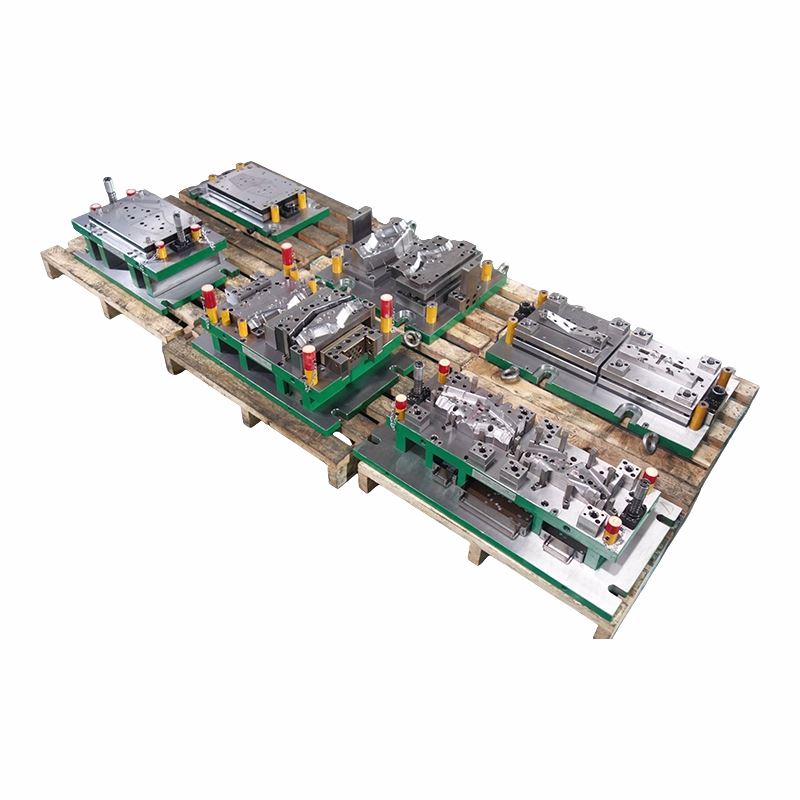
Single Operation Die for LH/RH Wheelhouse Reinforcement Brackets
This Single Operation Die project produces the left- and right-hand wheelhouse outer panel reinforcement brackets, part numbers ESEA-5401265 and ESEA-5401266.
The process contains five operations, but the tooling is arranged as three physical die sets. One LH and one RH part are produced per stroke from 0.65 mm DC53D+Z galvanized sheet on a 160T press.
At Changdong, we manage the three dies as one project. The important point is not how many steel blocks are on the shop floor, but whether the output from each operation is ready for the next one without forcing a locating or geometry problem downstream.

Product Parameters
|
Item |
Specification |
|
Product Name |
Single Operation Die |
|
Application |
Left / Right Wheelhouse Outer Panel Reinforcement Brackets |
|
Part No. |
ESEA-5401265 / ESEA-5401266 |
|
Digital Model Version |
_005_B |
|
Process Version |
V01 |
|
Part Material |
DC53D+Z |
|
Thickness |
0.65 mm |
|
Blanking Size |
302W × 167P × 0.65T mm |
|
Blank Type |
Strip, 302W × 0.65T mm |
|
Press Tonnage |
160T |
|
Parts per Stroke |
1 LH + 1 RH |
|
Process Quantity |
5 Operations |
|
Physical Tool Sets |
3 Die Sets |
Five Operations Do Not Mean Five Separate Dies
This project is a good example of why we do not judge a single-stage program only by the number of process steps.
There are five defined operations, but they are completed through three physical die sets. Where the released process allows it, more than one function can be arranged in the same tool instead of adding another complete die simply to keep every OP separate.
For Changdong, the decision still has to make sense on the press. Combining operations should reduce unnecessary tooling without making adjustment, loading or sample inspection harder.
We therefore keep the five process conditions identifiable even though the hardware is grouped into three tools.
The Five Samples Stay With the Tryout

Five process conditions shown together even though the project uses three physical die sets.
When all five samples are placed together, our toolmakers can see much more than they can from the final bracket alone.
If the final LH or RH part has a profile or hole-position issue, we compare the earlier samples before changing the last tool. A deviation that first appears in the second or third process condition should be corrected there instead of being hidden by a later adjustment.
This matters even more when one physical die contains more than one operation. We need to know which function inside that tool changed the part, not simply record that "Die No. 2" needed correction.
LH and RH Stay Paired Throughout the Route
The project output is 1 LH + 1 RH per stroke. We therefore compare the two parts during the same trial instead of using one side as the only reference for the tool condition.
Where left and right geometry is genuinely mirrored, the tooling logic can remain common. Side-specific holes, flanges or local details are still checked against their own released part data.
If RH needs a local change and LH does not, we keep that distinction in the correction record rather than copying the same adjustment across both parts automatically.
0.65 mm Galvanized Sheet Needs Controlled Handling
DC53D+Z at 0.65 mm is relatively thin, so we pay attention to what happens to the part between the three dies as well as what happens during the press stroke.
A thin stamped bracket can be bent or marked simply through poor unloading or stacking. During trial work we therefore compare the free-state part with the condition immediately after stamping, especially around narrow flanges and unsupported areas.
The galvanized surface also gives us an early indication of unwanted contact. If scratching begins after one operation, we inspect that die first instead of polishing all three tools.
On this Single Operation Die project, keeping the five samples separated by process makes that kind of troubleshooting much faster.
The 160T Press Matches Our In-House Trial Capacity
Changdong has three 160T presses in our own tooling facility. That gives this project a useful advantage during fitting and sample correction because the dies can be checked on the same nominal tonnage specified in the project data.
We use the press trial to confirm more than whether the tool closes. The actual stamped sample tells us whether locating, cutting and forming conditions are working together as expected.
If one of the three die sets needs adjustment, it can return directly to our fitting or machining area and come back for another trial without leaving the factory.
For a project with five operation conditions, that short correction loop is useful because we may need to compare several stages again after one local change.
Completed Three-Die Tooling Set

Three completed die sets used to carry the LH/RH wheelhouse reinforcement brackets through five process conditions.
What Changdong Keeps Under One Project
Three physical tools do not become three unrelated jobs after machining starts.
Our design, fitting and tryout teams keep the LH/RH parts, five operation conditions and three die sets under the same drawing and process revisions. If one tool changes, we can immediately check whether the next operation also needs to be reviewed.
The result we want from a Single Operation Die program is not simply three finished pieces of tooling. We want the complete five-operation route to remain understandable and repeatable when the customer puts those tools into production.
Hot Tags: single operation die, China single operation die manufacturers, suppliers, factory, gang bending die, metal stamping gang dies, metal stamping single station die, single hit dies, single operation metal stamping die, single station drawing die


