

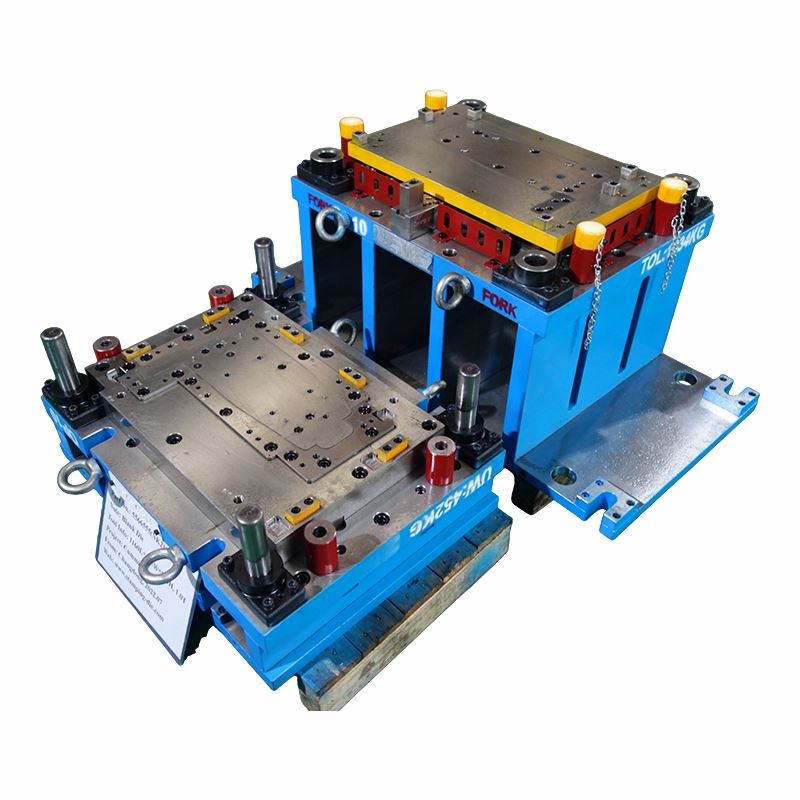
A metal blanking die is designed around the part perimeter, material thickness, strength, and the permitted burr direction. The blanking punch and die clearance determines rollover, burnish, fracture angle, burr height, and cutting load. Sharp internal corners can shorten tool life, while generous radii may conflict with the finished outline. Critical edges should therefore be identified on the drawing instead of applying one blanket requirement to the full profile.
Blanking die components include the cutting punch, die block, stripper, backup plates, guides, stops, and part or scrap ejection devices. A blanking die set should support the cutting perimeter evenly and keep the center of pressure within a stable area of the press slide. Large outlines may use sectional cutting steels so damaged zones can be replaced. Heat-treatment hardness, insert material, and standard parts are selected from the actual sheet grade, expected volume, and maintenance standard. On multi-cavity layouts, cavity-to-cavity load and blank size are compared so one side does not wear faster or create a different edge condition. Identification marks can help trace samples back to a specific cavity.
Thin or broad blanks can dish when stripping and knockout forces are not balanced. The finished blank needs enough support until it clears the cutting edge, then a controlled dropping-off path. Skeleton scrap should not drag across a cosmetic surface or fold into the working area. Chutes can use embossed sheet material for smooth movement, and a pneumatic cylinder-driven vibrator can assist where light offcuts bridge. Sensors may confirm discharge on unattended production.
Trial inspection covers outside profile, flatness, burr direction, edge wave, hole-to-outline relation if piercing is combined, and visible tool marks. Send the press specification and die technical standards, plus the current 3D drawing and dimensioned 2D drawing. Material condition, annual demand, and the approved inspection method should accompany them. Packaging requirements are relevant when broad blanks can be bent or scratched after stamping.
Blanking Die Certification and Technical Records
Blanking die work is evaluated by perimeter accuracy, burr condition, flatness, part separation, and controlled discharge of both blanks and skeleton scrap. The certificate module can include ISO 9001, high-tech enterprise certification, export qualification records, and patents for automatic blanking, piercing, cutting-edge structures, or smooth scrap-handling devices.
These records give buyers a practical reference when reviewing a Blanking Die supplier. They connect the die-design discussion with documented process control, wear-part management, first-off inspection, and manufacturing improvements intended to maintain stable output over repeated production runs.


Hot Tags: blanking die, China blanking die manufacturers, suppliers, factory


