

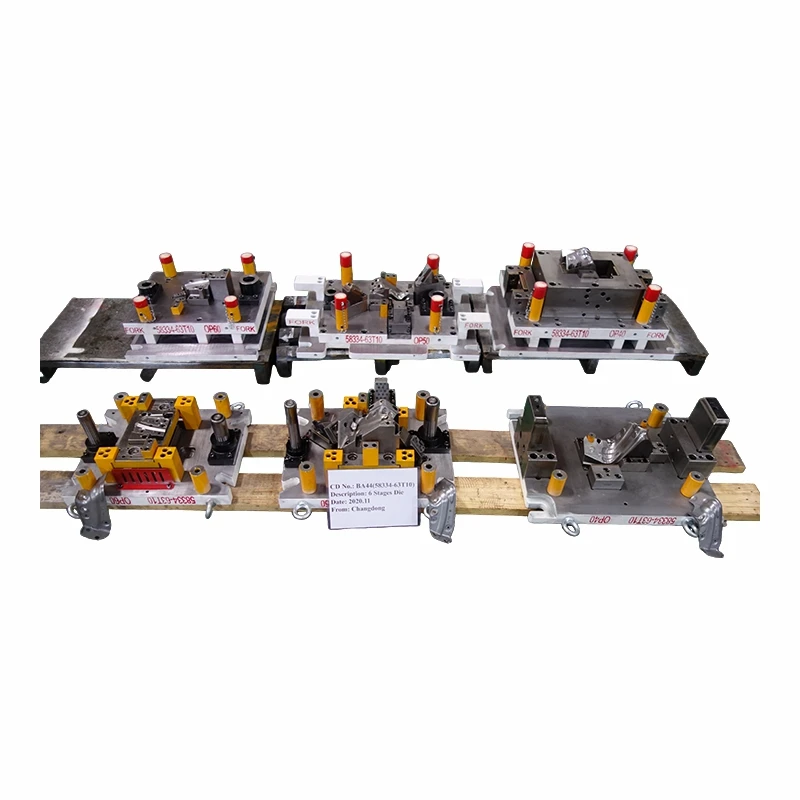
Sheet metal forming dies are used when repeatable profile and assembly fit are more important than the flexibility of a general bending machine. Press brake forming dies can be appropriate for open bends and low-volume work, but a dedicated tool provides better control of part location, overbend, and multiple features in one setup. The sequence should avoid trapping the part or closing a flange before later working areas remain accessible.
A tube forming die and a flat-sheet tool manage different section behavior, yet both require support around the active form. Material grade, thickness, rolling direction, bend radius, and work hardening affect springback. Overbend, restrike, local pressure, and staged forming may be used to bring the profile into tolerance. CAE simulation is useful for comparing sequences, especially where a broad surface could twist while a short flange is being formed. Grain direction can make nominally identical bends respond differently, so the blank orientation should be fixed before compensation is finalized. If the part has several bends, the datum-forming feature is normally stabilized first and secondary flanges are adjusted around it.
Forming die components may include punches, lower inserts, pressure pads, cams, lifters, stops, springs, and replaceable wear plates. Working surfaces should be polished in the sliding direction and relieved where the part must rotate during the stroke. Pressure should hold the datum without leaving tool marks. Access for shimming, die clamping, lubrication, and insert replacement is planned before the design is released.
Trial parts are checked for bend angle, surface or profile, hole position after forming, trimming line relationship, twist, and stable dropping off. Quotation work needs the press specification and die technical standards together with the 3D drawing and dimensioned 2D drawing. Expected volume and inspection requirements determine the adjustment features and spare-part plan. Approved checking fixtures or section templates should be available during tryout so profile corrections are based on measured data.
Forming Die R&D and Quality Support
Forming die projects require controlled pressure, stable datums, suitable working-surface finish, and a clear strategy for springback or local profile correction. The certificate area can display ISO 9001, high-tech enterprise recognition, export qualification records, and patents covering product-protection forming tools, anti-crush structures, continuous stretching, or profile-control die mechanisms.
For a Forming Die, these credentials support the technical explanation by showing that the supplier has documented engineering experience for non-cutting shape development. They are useful when customers need evidence behind forming-route selection, tryout correction, surface protection, and repeated part approval.


Hot Tags: forming die, China forming die manufacturers, suppliers, factory


