

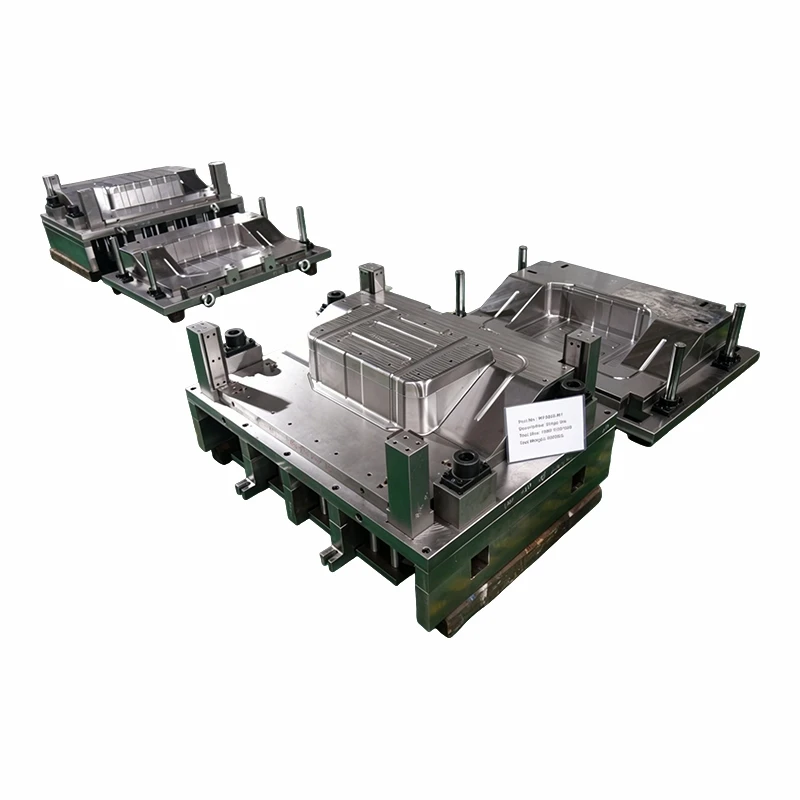
Deep Drawing Die for Controlled Sheet Metal Forming
When Changdong develops a Deep Drawing Die, we do not begin by assuming that more blank-holder pressure will solve every forming problem.
We first look at how much material has to move into the wall, where the sheet needs restraint, and which corners are likely to thin or wrinkle. Blank shape, draw radius, binder contact and draw-bead condition are considered together before the working surfaces are finalized.
The real target is a stable material-flow window: enough restraint to control wrinkles, but enough feed to prevent the sheet from being stretched unnecessarily.

Product Parameters
|
Item |
Specification |
|
Product Name |
Deep Drawing Die |
|
Tooling Process |
Sheet Metal Deep Drawing / Forming |
|
Engineering Support |
DFM / CAE Simulation / Die Design / Tryout Correction |
|
Tryout Focus |
Material Flow / Thinning / Wrinkling / Split / Released Profile |
|
Changdong Support |
Design / Machining / Fitting / Press Tryout / Sample Inspection |
We Do Not Freeze the Blank Too Early
The first blank outline is an engineering starting point. It is not automatically the final production blank.
During CAE review, we look at which areas are feeding into the wall and where excess material is likely to collect. That gives us a better first blank before steel is machined.
Once real samples come off the press, the blank can still be refined. Sometimes a small change around one corner gives the material more freedom to feed into a difficult wall. That can be more effective than increasing pressure across the complete binder.
We record those changes during development so the approved blank condition remains connected to the final tooling result.
CAE Gives Our Toolmakers a Better First Condition
Changdong uses AutoForm and Dynaform for forming analysis, together with CATIA and VISI in the die-development workflow.
Before machining the main forming surfaces, our engineers can review high-strain areas, likely wrinkle zones and the way material is expected to move around deeper walls and corners.
We use simulation to reduce the amount of blind correction at T0. It does not replace press tryout. Real material, lubrication, press condition and physical tool contact still determine the final result.
For a Deep Drawing Die, CAE is most useful when it gives the toolmaker a better place to start rather than pretending to eliminate the need for fitting.
Wrinkle and Split Need Opposite Corrections
We check where the sheet has too much freedom to enter the draw. Binder contact, local restraint and draw-bead condition are reviewed around the actual wrinkle area rather than simply increasing pressure everywhere.
We look for excessive stretching, tight radii or too much local restraint. Adding more holding force to a split area can make the condition worse, so the correction follows the material-flow evidence from the sample.
The tool usually needs local balance rather than one global setting. One area may need additional control while another needs more material feed during the same stroke.
We Mark the Sample Before We Grind the Tool
During T0 and later trials, our toolmakers use the actual stamped sample to decide where the next correction belongs.
A split location, wrinkle pattern, drag mark or unusual wall condition is compared with the corresponding punch, binder and die surface before steel is removed.
This matters because polishing the complete forming surface can make the tool look better without fixing the area that is actually controlling material flow.
We prefer local, traceable corrections. Change one condition, stamp again, and compare the next sample with the previous one.
Surface Finish Follows the Direction of Material Travel
Deep-drawn sheet slides across working surfaces as it enters the cavity. We therefore finish and polish those areas with the actual flow direction in mind.
Insert joints, local transitions and radii are checked carefully because a small discontinuity can become visible on the stamped wall after a long sliding contact.
Where galling or wear becomes a concern, the base steel, heat treatment and surface condition are reviewed first. TD or other suitable coating can be considered for selected working areas when the confirmed application justifies it.
For us, coating is not used to hide a poor forming surface. The geometry and contact condition have to be correct before additional surface treatment adds value.
Changdong Keeps Design, Machining and Tryout Close Together
Changdong has 13 die design engineers and an approximately 4,000 m² tooling facility in Dongguan. We carry out die design, CNC machining, WEDM, EDM, grinding, drilling, fitting and press tryout within the same tooling operation.
That is useful on deep-draw projects because the first trial often leads to a series of small, targeted corrections. A binder surface may need local work, a draw radius may need refinement, or the starting blank may need to change before the next sample is meaningful.
Instead of separating those corrections between different suppliers, our engineering and toolmaking teams can review the same sample and return the tool directly to fitting or machining.
This short loop is one of the advantages we bring to a Deep Drawing Die project.
What We Want to Confirm Before Handover
The final sample needs more than a clean outside shape.
We review the released profile, critical dimensions, wall condition, trimming reference and visible tool marks according to the customer's acceptance criteria. Where thinning is critical, the agreed measurement areas are checked against the approved requirement.
We also keep the approved blank and relevant tryout information connected to the project. If material behavior changes later, the production team has a known reference instead of starting the drawing process again.
The goal of a Deep Drawing Die is not simply to make one good shell. It is to leave the customer with a drawing condition that can be understood, repeated and maintained in production.
Hot Tags: deep drawing die, China deep drawing die manufacturers, suppliers, factory, drawing die, gang stamping die, metal stamping single station die, sheet metal gang dies, single operation stamping dies, single station progressive tooling


