

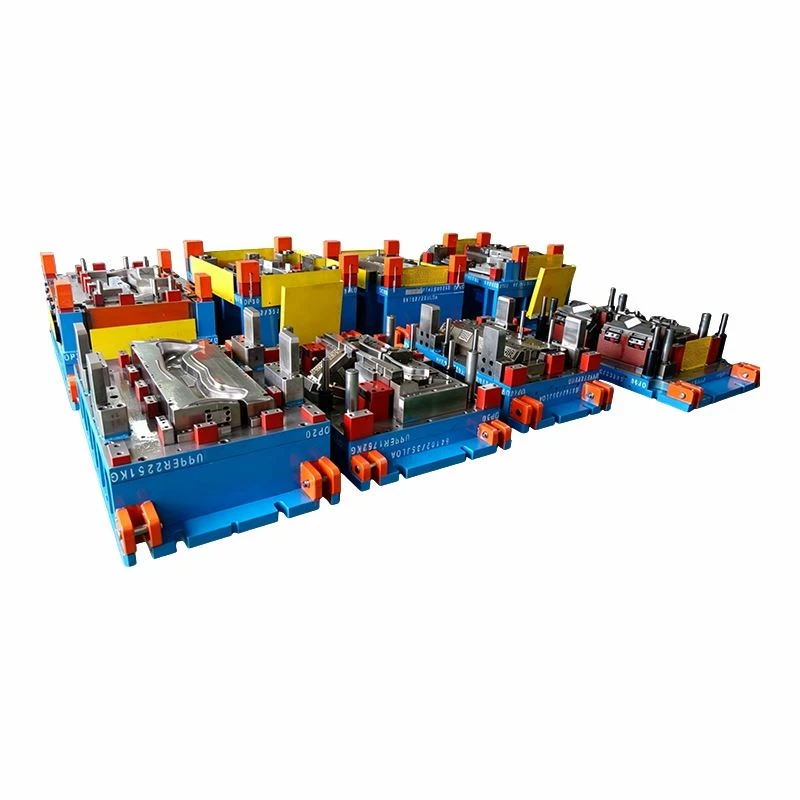
Transfer Press Tool for Robot-Hand Stamping Lines
For this Transfer Press Tool project, Changdong builds the individual cast-iron dies as one press-line package rather than treating every tool as a separate workshop job.
Robot transfer makes that important. If the installed height, locating reference or die position changes from one station to another, the robot may reach the programmed coordinate while the physical part is no longer where the line expects it to be.
Our work therefore starts with the complete line relationship: die position, press interface, transfer height and station-to-station consistency are reviewed together before the individual tools are finished.

Product Parameters
|
Item |
Specification |
|
Product Name |
Transfer Press Tool |
|
Tooling Configuration |
Multi-Die Press Line Tool Set |
|
Die Structure |
Cast-Iron Tooling Structure |
|
Part Handling |
Robot Hand Transfer |
|
Production Method |
Independent Dies in Sequential Press Operations |
We Set the Line References Before Treating the Dies Individually
A robot-transfer line becomes difficult to stabilize when every die has been built correctly on its own but the stations do not share the same installation logic.
At Changdong, we review the die centerline, press direction, clamping area and transfer reference across the complete tool set. The aim is to keep the workpiece at a predictable location from one press operation to the next.
This also makes later die changes easier. When the customer removes one tool for service and installs it again, the tooling should return to the same physical relationship with the press and robot instead of requiring the automation team to compensate for a different die position.
Die Height Consistency Reduces Robot Re-Teaching
When the open-die working level is controlled from station to station, the robot does not have to compensate for unnecessary vertical differences created by inconsistent tooling setup.
We coordinate the resting condition of the incoming workpiece with the transfer reference used by the line. This gives the next die a more repeatable starting condition before locating takes over.
A known installation reference helps the customer return a serviced die to the original line condition without using robot programming as the first method of correcting a mechanical setup difference.
Cast-Iron Dies Are Machined as Parts of the Same Program
For a multi-die project, we want the machining references to remain consistent across the complete set.
The cast structures first receive defined datum surfaces. Working areas, locating components and guide-related machining are then built from those references. This gives our assembly team a common basis when the individual tools come together for line review.
Changdong has a 3-meter gantry CNC, conventional CNC capacity, six WEDM machines, EDM, grinding and high-speed drilling in the same tooling facility. On a group of dies, that lets us schedule large structural work and precision inserts in parallel instead of completing one entire tool before the next can move forward.
The value is not simply having more machines. It is being able to keep several dies from the same Transfer Press Tool program under one manufacturing schedule and one engineering revision.
We Check the First Line Cycle Slowly
When the individual dies begin working together, we do not use production speed to hide a poor handoff.
The early cycles are useful for watching where the intermediate part actually sits after each press opens. We compare that condition with the robot pickup position and with the locating condition of the next tool.
If one station repeatedly requires a larger correction than the others, we separate the causes. It may be the stamped part shape, die installation position, robot placement or the next locating surface. These are different problems and should not all be corrected through the automation program.
Once the handoff becomes repeatable, cycle speed can be increased while the same reference positions are monitored.
A Stable Line Depends on More Than Robot Accuracy
The robot can repeat its coordinate accurately and still receive a workpiece that has changed because the previous stamping operation is unstable. We therefore look at the stamped result before changing robot positions.
A mechanically shifted die changes the real pickup or placement point even if the robot program has not changed. Setup references help us distinguish that condition quickly.
The workpiece should arrive close enough to its intended nest that the die can complete final location without dragging or distorting the part.
Completed Cast-Iron Press Tool Set

The completed cast-iron dies are prepared as one press-line tooling program linked by robot-hand transfer.
Changdong Keeps Engineering, Toolmaking and Tryout Connected
Changdong has 13 die design engineers and an approximately 4,000 m² tooling facility in Dongguan. Design, machining, fitting and press tryout are coordinated within the same project team.
Our press capacity ranges from 45T to 800T. For suitable programs, this allows us to confirm individual stamping operations and tooling corrections before the tool set is prepared for shipment.
For overseas projects, we also use an English communication loop and timing plan to track major engineering and manufacturing stages. When a change affects more than one die, the customer can see which station changed and why instead of receiving several disconnected workshop corrections.
Automotive Quality Control Behind the Line Tooling
Our automotive quality-management records support controlled drawings, project revisions, inspection records and tooling changes throughout development.
This matters on a group of robot-transfer dies because a change at one station can affect the next station's workpiece position or the line setup.
For a Transfer Press Tool program, we keep those changes tied to the same controlled project data so the final tooling set, approved samples and line references remain understandable after handover.

Hot Tags: transfer press tool, China transfer press tool manufacturers, suppliers, factory, industrial stamping dies, multi station transfer dies, precision metal tandem die, tandem line die, tandem production die, transfer trimming die


