
Transfer Stamping Die – Six Stations From OP10 to OP60
This Transfer Stamping Die was developed as a six-station project, arranged through OP10, OP20, OP30, OP40, OP50 and OP60. OP30-40 are integrated into one die group, and OP50-60 are also built together, giving the complete project four main tooling groups.
That layout makes the intermediate part condition especially important. A dimensional or locating problem created in one operation does not stay at that station; it follows the part into the next tool. During engineering and tryout, the part is therefore checked between operations instead of judging only the finished sample at OP60.
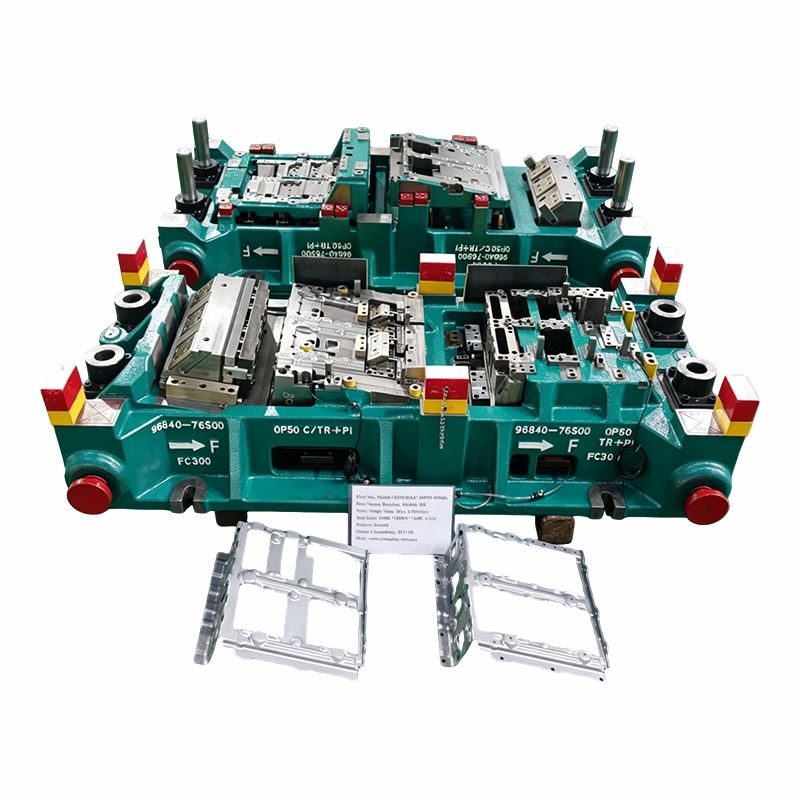
The OP50-60 Transfer Stamping Die measures 1940L × 1100W × 710H mm and weighs approximately 4.83T. The project was developed for a Suzuki program.
Project Snapshot
• 6 stamping stations
• OP10
• OP20
• OP30-40 combined tooling
• OP50-60 combined tooling
• OP50-60: 1940 × 1100 × 710 mm
• OP50-60 weight: 4.83T
Why Choose Us for Transfer Tooling
Each operation is reviewed together with the condition required by the next station, helping avoid downstream correction for a problem that actually started earlier in the sequence.
Changdong's in-house press capacity includes 800T, 400T, 260T, three 160T presses and one 45T press, supporting different tooling sizes and forming loads.
Tooling capability extends to approximately 4 meters, supported by a 3-meter gantry CNC, high-speed drilling and in-house assembly.
Six WEDM machines support cutting inserts, precision profiles and tooling components alongside CNC machining and fitting work.
Six Stations, Four Tool Groups
A six-station transfer process gives each operation room to perform its own work without forcing too many forming, trimming or piercing functions into one die. It also creates more opportunities to check the part between operations.
For this Transfer Stamping Die project, OP10 and OP20 are individual die groups. OP30 and OP40 share one tooling group, while OP50 and OP60 are combined in another. The arrangement means the interaction between paired operations needs to be considered during both design and tryout.
Keeping parts from different operations makes it easier to see where profile, flange position, trimming condition or hole location first begins to change. That is usually more useful than trying to diagnose everything from the final OP60 part.

OP10 open-tool view from the six-station transfer project.
OP10: Establishing a Repeatable Starting Condition
The first station needs to leave the part in a condition that later tools can locate and process consistently. If the part begins the sequence with unstable shape, uneven contact or an unreliable datum, later stations may compensate for the problem without removing its cause.
During initial tryout, the OP10 part is therefore checked before attention moves further down the line. The aim is simple: confirm that the next station receives a repeatable part instead of inheriting a variable one.

OP20 open-tool view showing the next independent operation in the transfer sequence.
OP20: Check the Part Before the Combined Operations
The intermediate part should sit naturally in the next tooling position. If operators have to push or twist it into place, the problem may already exist upstream.
This matters before OP30-40 because two operations are integrated into the following tooling group. Entering that die with an unstable part makes later diagnosis more difficult.
Scratches, local pickup or visible tool marks can begin before the final operation. Looking at intermediate parts helps identify which die contact caused the issue instead of discovering it only at the end of the process.

OP30-40 combined tooling, with two operations integrated into one die group.
OP30-40: Two Operations Sharing One Tooling Group
When OP30 and OP40 share one die, adjustments cannot be treated as if the operations were completely independent. A change to locating, forming position or the part condition at OP30 may influence how the workpiece reaches OP40.
This is one reason the Transfer Stamping Die is checked operation by operation even when two stations are housed within the same die group.
Working inserts, locators, sensors and adjustment points need enough access for tryout changes and later maintenance. Saving die space is useful only if normal service work remains practical.
Where trimming or piercing is carried out, scrap should leave the working area without crossing the part path or interfering with the second operation inside the tool group.

OP50-60 combined tooling. Tool size: 1940 × 1100 × 710 mm; tool weight: approximately 4.83T.
OP50-60 Tool Information
|
Item |
Confirmed Information |
|
Project Type |
Six-Station Transfer Stamping Project |
|
Project |
Suzuki |
|
Tool Group |
OP50-60 |
|
Tool Size |
1940L × 1100W × 710H mm |
|
Tool Weight |
4.83T |
OP50 and OP60 share one physical tool group, but each operation still needs a defined result. During tryout, the part condition entering OP50 and the final result leaving OP60 are checked separately.
The 4.83T tool also needs suitable lifting, clamping and maintenance access. These details matter during installation just as much as they do in the tool shop.
Tryout Is About Finding Which OP Owns the Problem
When the final part shows a profile, hole-position or trimming-line deviation, the first question is not simply how to correct OP60. Intermediate samples help show whether the change began at OP20, OP30, OP40 or later.
This is particularly valuable on a six-station Transfer Stamping Die, where correcting the wrong operation can create another problem further down the sequence.
If a part lands differently from stroke to stroke, the cause may be pickup position, locating, part orientation or transfer timing rather than the forming surface itself. These conditions are checked before working steel is modified unnecessarily.
T0 can identify the remaining dimensional and appearance corrections. Final OK samples are submitted only after the agreed inspection requirements have been met.
Manufacturing Support Behind the Project
Large die plates and structures can be machined on the 3-meter gantry CNC, which is useful for transfer tooling with longer working areas.
The press line includes 800T, 400T, 260T, three 160T machines and one 45T press. Feeders are also available for relevant stamping trials.
Six WEDM machines support precision cutting of inserts and profiles alongside CNC machining, drilling, assembly and tryout.
The factory provides machining, assembly and tryout space for larger Transfer Stamping Die projects and multi-tool programs.
What We Need for a New Transfer Stamping Project
For a new Transfer Stamping Die quotation, please send the 2D drawing, matching 3D model, die technical standards and target press specification.
Material grade and thickness, surface requirements, critical assembly dimensions, expected annual volume, transfer-equipment information and sample approval criteria are also useful. If the project requires specific inserts, component brands, TD coating, spare parts or checking fixtures, identify them before the tooling scope is finalized.
This information allows the forming sequence, tooling split, press fit and tryout plan to be based on the actual project instead of assumptions.
Recommended RFQ Data
• 2D drawing
• 3D CAD / STEP model
• Material and thickness
• Die technical standards
• Press specification
• Transfer equipment
• Surface requirements
• Critical dimensions
• EAU
• Sample approval criteria
FAQ
Hot Tags: transfer stamping die, China transfer stamping die manufacturers, suppliers, factory, large sheet metal tandem dies, large tandem dies, precision metal tandem die, progressive stamping tooling, tandem production die, transfer trimming die


