

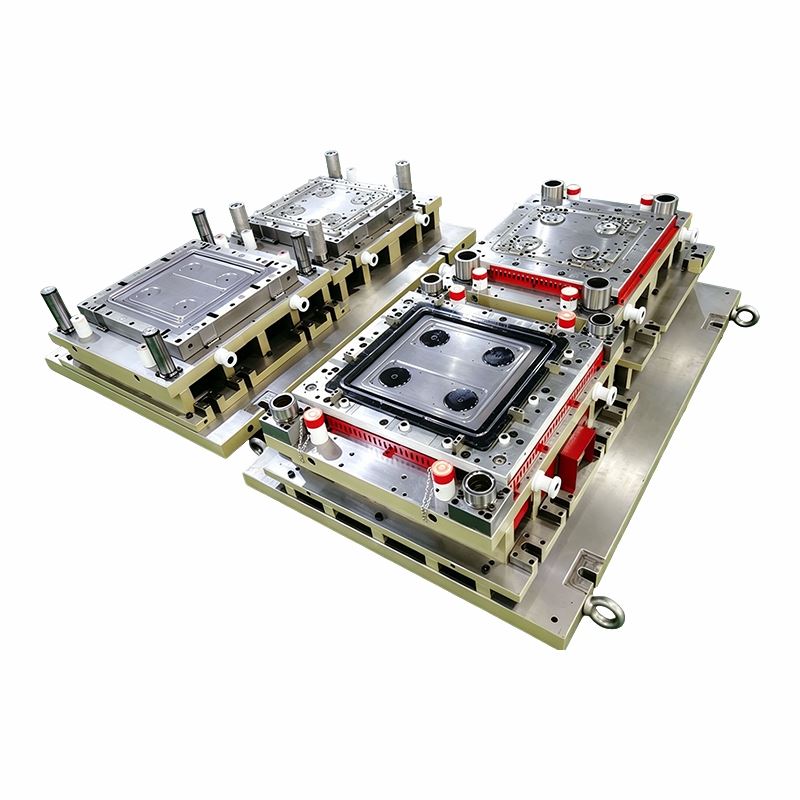
Transfer tooling components should be defined as one working package: die stations, transfer fingers, sensing, clamps, lifters, and the final dropping off arrangement. Each station needs a clear responsibility, and the open height must leave room for entry and exit without contacting the part surface. For sheet metal transfer tooling, intermediate shapes often control the next pickup more than the final geometry does. A stable locating feature is therefore retained until the process no longer needs it. Press bolster size, shut height, line direction, and die clamping points are checked before the layout is frozen.
A good transfer production tooling concept does not treat part movement as an afterthought. Finger approach, grip location, rotation, and clearance are reviewed beside the draw and trim sequence. The part should arrive at the next station without rocking or being forced onto the locator. Where a panel has a sensitive surface or profile, pickup points are moved to non-cosmetic areas. Sensors can confirm part presence, but they do not correct poor orientation; mechanical support and repeatable datums still carry the process.
During transfer tooling assembly, maintenance access matters as much as initial build accuracy. Wear inserts, guide elements, cams, and pressure parts should be removable without stripping unrelated sections. Die steel and heat-treatment hardness are selected according to load, material, and expected volume. Standard parts may follow the buyer's approved list. Scrap paths should remain visible and easy to clean; embossed sheet material can be used on chutes where a smooth sliding surface helps prevent bridging.
Quotation work should start from the customer's 2D drawing and matching 3D drawing. The die technical standards should then be checked against the intended press specification. Annual demand, material grade, tolerance plan, and inspection requirements clarify the build level. Changdong can use those inputs to review the station split, handling concept, tool size envelope, and tryout plan before steel is released.
Transfer Tooling Qualification Records
Transfer tooling projects depend on controlled station handover, reliable pickup areas, protected surfaces, and repeatable part orientation. The certificate module can include ISO 9001, IATF 16949 for automotive transfer programs, export operation qualification, high-tech enterprise recognition, and patents for multi-process die structures or workpiece transfer mechanisms.
These documents help overseas buyers evaluate the supplier before committing to a press-line project. For Transfer Tooling, they demonstrate that process planning, handling review, tryout correction, and maintenance documentation are supported by formal quality records and accumulated patented tooling development.


Hot Tags: transfer tooling, China transfer tooling manufacturers, suppliers, factory


