

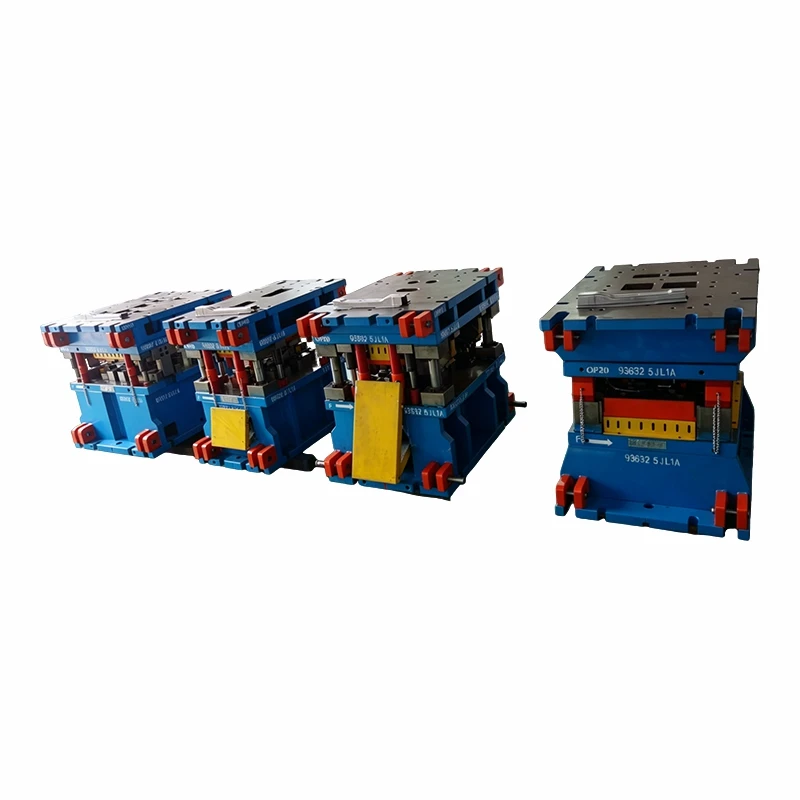
Transfer stamping tooling must fit the real line, not an idealized press envelope. The review covers bolster size, shut height, daylight, stroke, transfer pitch, finger entry, and the direction used for die clamping. A transfer production stamping tool may need different open-space allowances from a manually tended tool, especially around cams and tall formed walls. The intended speed is considered, but stable pickup and landing take priority over a nominal cycle target. Guarding and cable routes are included in the envelope because an accessible sensor is more useful than one blocked by the transfer rail.
A transfer stamping tool set includes more than the upper and lower die blocks. Locators, lifters, pressure pads, cams, sensors, transfer nests, and service items all affect repeatability. Standard parts can follow the customer's die technical standards; MISUMI is commonly used, with Danly or FIBRO alternatives considered where dimensions, load rating, and maintenance practice match. Working inserts are selected for toughness or wear resistance as needed, and heat-treatment hardness is documented instead of being left to shop habit.
In a sheet metal transfer stamping tool, the intermediate part should be easy to grip without marking the visible surface. Fingers need enough support to prevent rotation during acceleration, yet they must clear the profile as the press closes. A transfer forming tool may use temporary locating features that disappear at a later trim. Sensors confirm presence, while positive nests establish position. Final dropping off and scrap evacuation are tested at production speed after the forming sequence is stable.
For quotation, provide the die technical standards and press specification, followed by the 2D drawing and 3D drawing. Include material, planned handling equipment, annual volume, and inspection datums. Changdong can then review press-line fit, operation split, maintenance access, and the practical tryout scope before committing to the tool design. Any customer-specific approval stages should be listed at the same time.
Transfer Tool Qualification Documents
A transfer stamping tool requires stable handoff between forming stations, accurate workpiece location, and repeatable coordination with transfer fingers or grippers. The certificate module can display IATF 16949, ISO 9001, export qualification records where required, high-tech enterprise certification, and patents for quick-change structures, transfer-related locating devices, or multi-process die mechanisms.
These documents give overseas buyers a clearer basis for supplier evaluation before releasing line data and controlled part drawings. For a Transfer Stamping Tool, the supporting evidence connects process planning, tool construction, transfer motion review, and tryout correction with a documented quality and engineering system.


Hot Tags: transfer stamping tool, China transfer stamping tool manufacturers, suppliers, factory


