

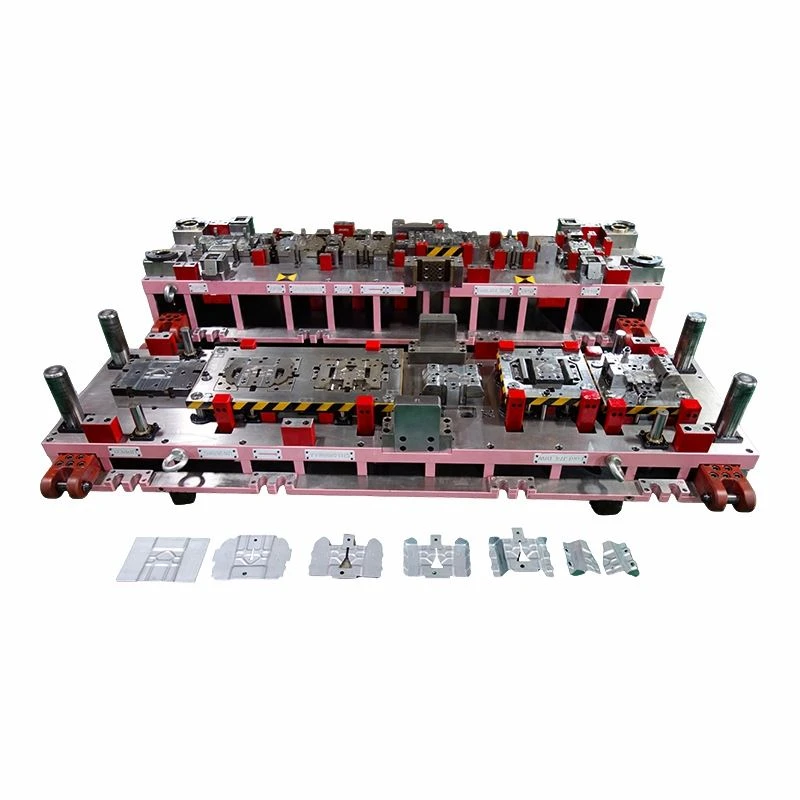
An automotive sheet metal transfer die may handle a large outer panel or a smaller structural member; the engineering priorities are not the same. Visible panels need controlled contact and protection from scratches, while reinforcement parts place more emphasis on flange location, hole position, and assembly fit. For an automotive panel transfer die, the draw creates the reference surface for later trimming and piercing. For structural work, local strength and springback may govern the restrike and calibration stages. Joining features should be tied to body-in-white datums so inspection results relate directly to assembly fit rather than isolated dimensions.
The Automotive Transfer Die process is reviewed across every intermediate shape. An automotive body transfer die needs stable pickup zones that do not distort the surface or profile. An automotive forming transfer die may use draw beads, pressure control, and restrike surfaces to manage material movement and springback. During tryout, engineers track trimming line, mating datums, hole position, flange angle, and tool marks instead of judging only the final outline. Sharp transitions are corrected at their source; excessive polishing is not used to mask a geometry problem.
An automotive stamping transfer die must also match the handling equipment. Finger reach, gripper direction, press spacing, daylight, and safe clearance are checked against the actual line. CAE simulation can guide blank development and highlight thinning or wrinkling risk, but physical panels are measured after each major operation. Corrections are made at the station where the variation begins, which avoids compensating for one error by adding another downstream. Part handling is then retested after each geometry correction because pickup stability can change with the panel shape.
For an Automotive Transfer Die quotation, submit both a 2D drawing and 3D drawing, plus the intended press specification and the die technical standards that govern the build. Material data, surface classification, annual volume, joining datums, and the proposed transfer method should accompany them. Changdong can then review the operation split and tryout plan against confirmed project requirements.
Hot Tags: automotive transfer die, China automotive transfer die manufacturers, suppliers, factory


