

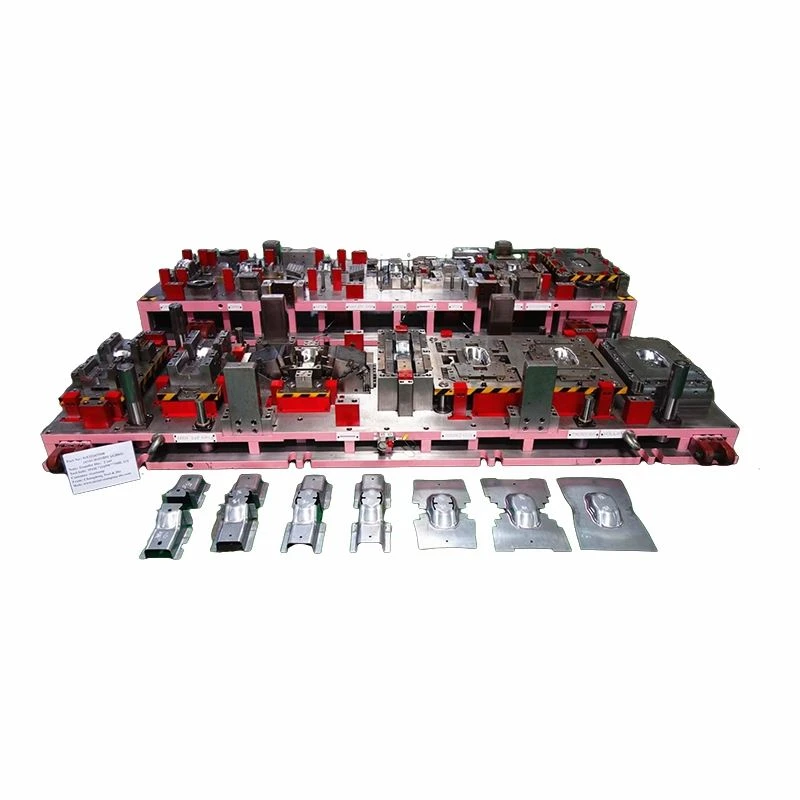
Tandem Stamping Tool Planned as a Complete Press-Line System
A Tandem Stamping Tool project should be planned as a connected production line, even though each die performs its own operation. Draw, restrike, trim, pierce, flange and final calibration stages need to work with the available presses, handling method and inspection sequence.
The main delivery risk is often not one individual die. A slow operation, unstable pickup direction, difficult part rotation or inconsistent locating condition can affect the output of the entire tandem line. For this reason, operation ownership and part movement are reviewed together before tooling is released for manufacturing.
Changdong develops each Tandem Stamping Tool around the required result of that station and the condition needed by the next operation. During tryout, intermediate samples, datums, handling points and line-transfer conditions are checked so problems can be identified before they become line-level delays.
Why Choose Us
Each die is reviewed as part of the complete tandem sequence so one overloaded operation does not become the bottleneck for the whole production line.
T0 samples are checked against the drawing and the defined result of each operation before the next correction stage is planned.
Pickup direction, part rotation, locator access and robot or manual handling conditions are considered before the tandem sequence is finalized.
Die height, clamping direction, lifting points, safety blocks and inspection datums are documented consistently across the Tandem Stamping Tool set.
Plan the Line Before Optimizing Each Individual Die
A tandem line may use separate dies for drawing, restriking, trimming, piercing, flange forming or final calibration. The number of operations is not the only concern. Each operation also needs enough process margin to run without becoming the slowest stage in the line.
Secondary features should not automatically be added to an operation that already carries the main drawing or forming load. Moving a feature to another die can sometimes give the process more stability and make line balancing easier.
Press tonnage, shut height, daylight, bolster space and stroke need to suit the operation assigned to each die. Differences between presses can also affect how the workpiece is lifted, rotated or positioned before entering the next station.
When robots are used, grip change, part rotation, transfer distance and recovery clearance after a stopped cycle should be included in the line study. With manual or semi-automatic handling, pickup access and operator safety become equally important.
Each Tool Owns a Defined Result
The drawing operation should establish the material distribution and geometry needed by the following dies. If springback or local surface movement remains significant, a separate restrike can be used before later features are finalized.
Trimming and piercing should follow stable locating conditions. Piercing too early can allow later forming or springback to move the hole relative to the final profile. Retaining useful datums until the correct stage helps both tooling and inspection teams track the part consistently.
The final Tandem Stamping Tool operation should have a defined target such as flange angle, surface / profile, dimensional stability or assembly fit. A final station should not exist only because the line traditionally includes one.

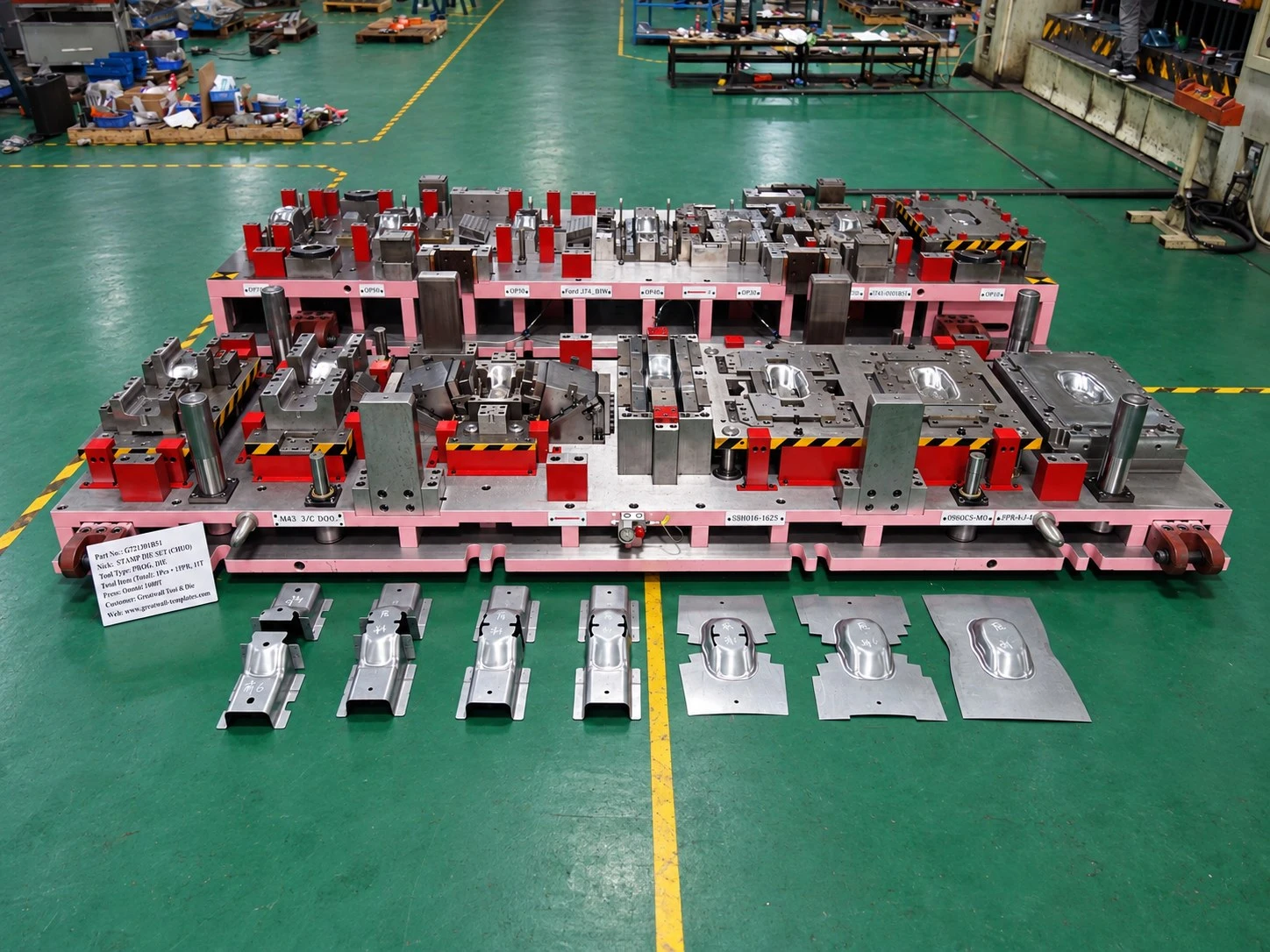
Intermediate samples showing how the part develops through separate tandem operations before final calibration.
Intermediate Samples Show Where the Deviation Starts
Each intermediate sample can be compared with the expected process condition. Draw depth, flange angle, surface / profile, trimming line and local springback are easier to correct when the operation that first creates the deviation is known.
For a Tandem Stamping Tool project, this is especially important because a dimensional problem found at the end of the line may actually originate two or three dies earlier.
Intermediate locating surfaces or holes may be retained until they have completed their handling and inspection function. Removing them too early can make later positioning less repeatable and increase uncertainty during measurement.
Pickup areas and sliding directions should avoid surfaces that are sensitive to scratches, dents or tool marks. Forming and handling therefore need to be reviewed together when the part contains visible or assembly-critical surfaces.
Line Trial Is Different From Testing One Die at a Time
A die may produce an acceptable part individually while the complete line still has handling or timing problems. During line trial, the workpiece needs to move from one operation to the next without being forced onto locators, rotated inconsistently or damaged during pickup.
T0 samples can be checked for dimensions, hole position, flange condition, trimming line, surface / profile, burrs, scratches and visible tool marks. Changdong's T0 first-sample qualification rate is above 85%.
Remaining issues are assigned to the operation that controls the result before correction begins. This helps prevent a later die from being modified to compensate for a problem created earlier in the sequence.
Robot speed should be increased only after pickup, part orientation and placement are repeatable. Stable locating is more important than reducing transfer time during the first line trials.
Consistent Tool Setup Reduces Line-Side Adjustment
Die setup sheets and inspection documents should identify datums consistently. Using different references between tooling, quality and production can create confusion when a part needs adjustment during line trial.
Die height, clamping direction, lifting points, safety blocks and sensor brackets should be documented for each member of the tandem set. These details influence setup time and maintenance access after the tooling reaches production.
Common punches, inserts and other wear components can be designed for replacement where practical. Working steel, hardness and heat treatment are selected according to the operation instead of copying one material specification across all dies.
Ready for Line Handover, Not Just Tool Completion

Completed tooling prepared for final setup verification and production-line handover.
Before handover, each Tandem Stamping Tool should be checked against the relevant press specification, handling method and setup condition. A successful single-die tryout does not replace line-level compatibility review.
Adjustment points, replaceable inserts, sensor brackets and common service components should remain accessible after the tool is installed. Maintenance planning is part of keeping the tandem line available rather than only a tooling-shop consideration.
Depending on project requirements, setup information, tryout findings, sample inspection results and correction notes can provide a reference when the customer commissions the line or later needs to trace an operation-specific issue.
What We Need to Review Your Tandem Line
To evaluate a Tandem Stamping Tool project, please provide the 2D drawing, 3D drawing, die technical standards and press specification for the intended line. Press spacing and the proposed handling method are particularly useful for tandem tooling because they influence operation allocation and part transfer.
Material grade and thickness, EAU, critical dimensions, inspection datums, required sample quantity and target delivery schedule are also helpful. If robots are already selected, gripper information, rotation requirements and transfer clearance should be included where available.
Once the project information is complete and clear enough for evaluation, Changdong can arrange engineer-led feedback within 24 hours and review the operation split, handling risks, line-trial requirements and project timing before the next step is confirmed.
Tandem Line Review Data
• 2D drawing
• 3D CAD / STEP model
• Die technical standards
• Press specifications
• Press spacing
• Robot / handling information
• Inspection datums
• EAU
• Target delivery schedule
FAQ
Hot Tags: tandem stamping tool, China tandem stamping tool manufacturers, suppliers, factory, large sheet metal tandem dies, large tandem dies, sheet metal dies, sheet metal stamping dies, tandem trimming dies, transfer metal forming dies


