

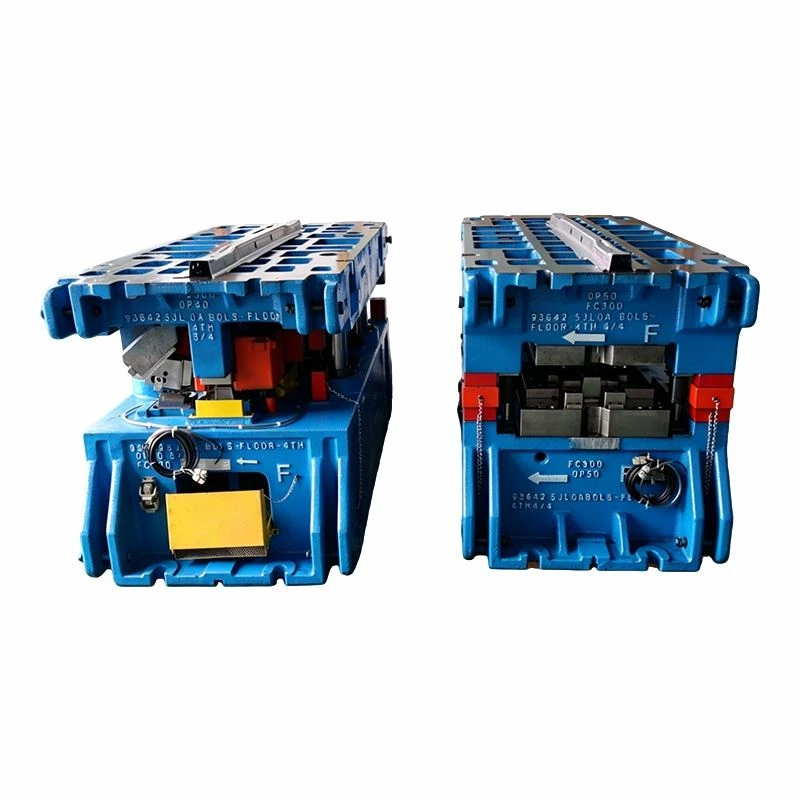
A transfer drawing press die establishes the early geometry that later stations depend on. Blank shape, draw direction, binder force, draw beads, and corner radii are reviewed before the cut edges are fixed. A transfer forming press die may then restrike a wall, set a flange, or correct springback without reopening the draw. The sequence should preserve enough stiffness for handling and avoid cutting away a feature that the next station still needs as a locator. Blankholder transitions are kept smooth so one station does not create a wrinkle that the next station merely flattens and hides.
Transfer press die components are specified according to load and service conditions. Drawing inserts require toughness and smooth contact surfaces; trim steels need wear resistance and a controlled cutting clearance. The upper and lower structures should limit deflection under uneven loads. Replaceable inserts are useful at high-wear radii and trimming areas. Lifting points, safe blocks, sensors, and die clamping locations are arranged so maintenance work can be carried out without removing unrelated assemblies.
With a sheet metal transfer press die, final dimensions depend on what happened in every earlier operation. Tryout checks therefore include draw depth, surface or profile, trimming line, hole position, flange angle, springback, and tool marks. The part must enter each nest freely; forcing it into location can hide an upstream error. CAE simulation helps identify risk areas, but sample measurement and panel comparison remain the basis for final correction.
FAQ
Hot Tags: transfer press die, China transfer press die manufacturers, suppliers, factory


