

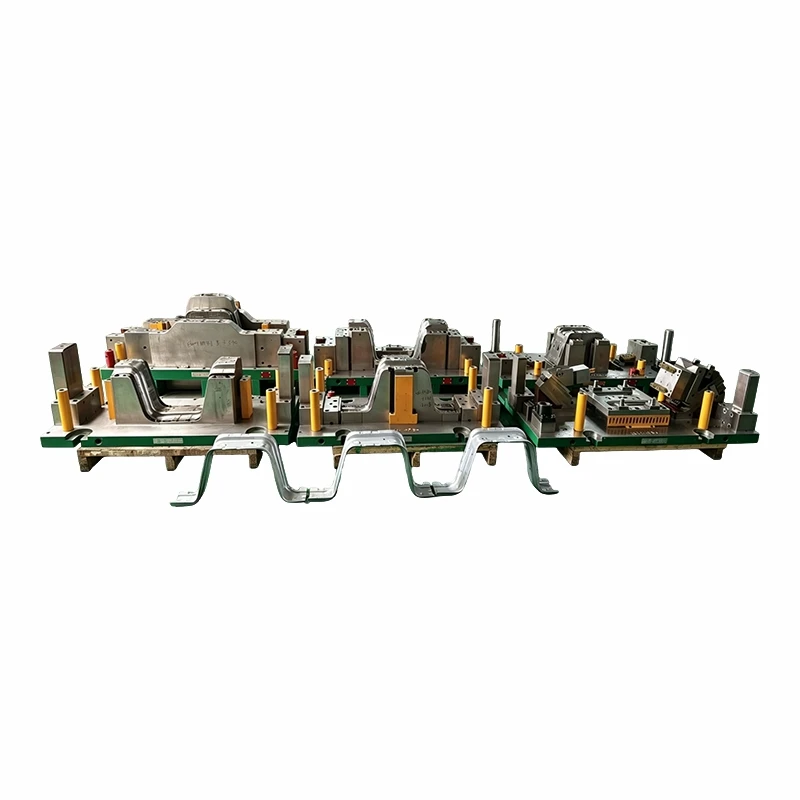
A metal press mould at OP10 may establish the main form or blank reference, while later tools can trim, pierce, flange, or calibrate the part. The exact split should follow the drawing and press limits, not the operation number alone. In this Press Mould set, each stage needs an agreed input and output condition. If OP20 changes a surface or profile, OP30 locators must be based on that new geometry. This avoids forcing the workpiece into a nest and hiding an error created earlier in the line.
A sheet metal compression mould or press forming mould may use different working steels and pressure systems, but the dies still need common setup logic. Lifting points, die clamping direction, shut-height references, safety blocks, and inspection datums should be documented in the same way across OP10-OP50. A press tooling mould also benefits from interchangeable standard components where the customer's die technical standards permit. Common spare punches, guide parts, and springs reduce maintenance complexity without pretending that every working insert is identical.
The industrial press mould sequence is tried one operation at a time before the complete line is evaluated. Engineers track trimming line, hole position, flange angle, profile, and tool marks to the operation that owns each feature. The Press Mould set should allow parts to enter and leave without scraping finished surfaces. Where parts or scrap drop through the lower tool, smooth embossed-sheet chutes and a pneumatic cylinder-driven vibrator can be used to prevent bridging. After individual correction, the full OP10-OP50 route is run to confirm cumulative dimensional stability.
For every operation in the set, supply its press specification and die technical standards, plus the 2D drawing and 3D drawing. The operation sheet should also identify part orientation, handling method, press assignment, material condition, inspection datums, and sample requirements. These files let the engineering team verify that the tools work as one process rather than five unrelated builds.
Hot Tags: press mould, China press mould manufacturers, suppliers, factory


