

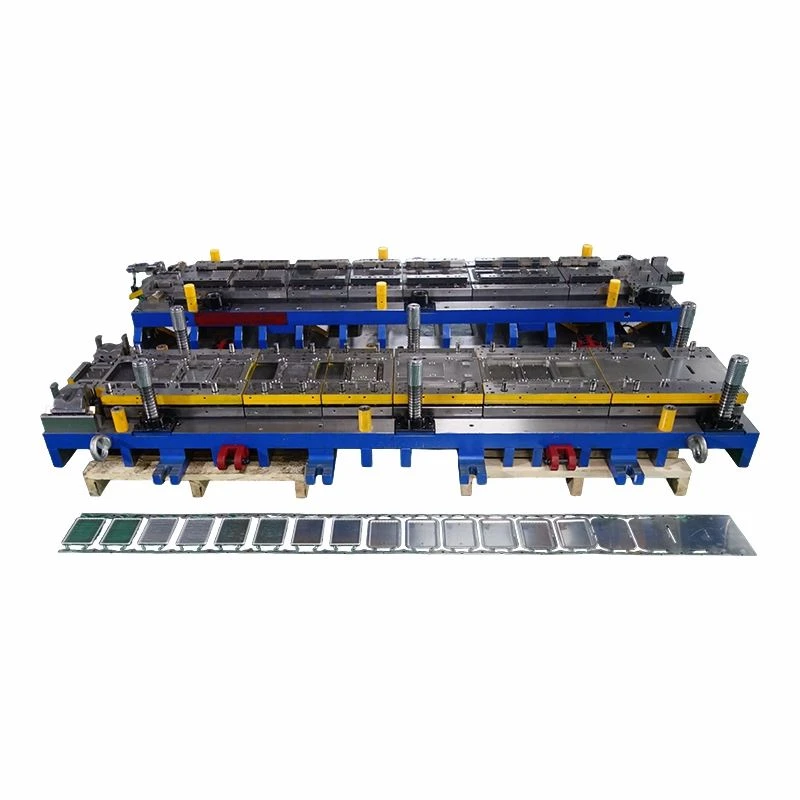
Metal Press Tool for Aluminium-Brazed WCAC Header Production
This Metal Press Tool was developed for a BMW aluminium-brazed WCAC header project. It is a 1-out progressive die for 1.78 mm Aluminum Alloy 3916, with a maximum strip width of 220 mm and a maximum progression of 144 mm.
The finished tool measures 2900L × 850W × 595H mm and weighs approximately 4.95T. The specified press tonnage is 400T.
Aluminium progressive tooling has its own problems. Pickup can build on forming surfaces. A clean part at the beginning of a trial can start showing scratches after repeated strokes. Burr condition, springback and strip stability also need to be watched together. The tooling is therefore adjusted from the actual strip and sample condition, not only from the nominal CAD geometry.

Product Parameters
|
Item |
Specification |
|
Product Name |
Metal Press Tool |
|
Application |
Aluminium-Brazed WCAC Header |
|
Tool Type |
Progressive Die |
|
Output |
1 Out |
|
Material |
Aluminum Alloy 3916 |
|
Thickness |
1.78 mm |
|
Maximum Strip Width |
220 mm |
|
Maximum Progression |
144 mm |
|
Tooling Size |
2900L × 850W × 595H mm |
|
Tool Weight |
Approx. 4.95T |
|
Press Tonnage |
400T |
Why This Aluminium Tool Needs Different Handling
Aluminium can build up on a punch or forming insert after repeated contact. Once that happens, the surface condition changes and later parts may show drag marks, scratches or dimensional variation.
Simply polishing the insert again is not enough if the contact pressure, radius or lubrication condition remains unchanged.
The stamped header continues into another manufacturing process. Pierced and trimmed edges are therefore checked for burr direction, deformation and local damage according to the drawing and downstream requirements.
Compensation is based on actual sample results. One general aluminium springback value is not applied to every bend or forming station.

Progressive trial strip showing the aluminium header through the stamping sequence.
220 mm Strip Width, 144 mm Progression
The 220 mm strip envelope has to hold the part, pilots, carrier bridges and scrap areas. As material disappears through piercing and trimming, the remaining carrier still needs enough stiffness to travel through the later stations without twisting.
The progression is not controlled by the feeder alone. Pilot entry, guide condition and carrier rigidity all affect the final strip position.
If several features shift in the feed direction at once, strip positioning is checked before working components in the Metal Press Tool are modified.
Intermediate stations make it easier to see whether a hole, bend or local profile begins to change during piercing, forming or later springback.
How Changdong Builds a 2.9 m Progressive Tool
The 2900 mm tool length falls within Changdong's 3-meter gantry CNC machining range. Large plates and major structures can therefore remain inside the same tooling schedule instead of being split into unrelated machining work.
Six WEDM machines support cutting inserts and precision profiles while CNC machining, drilling and fitting continue on other tool components.
Large plates often contain many assembly, guide and service holes. High-speed drilling keeps this work from occupying large CNC machining time unnecessarily.
This project specifies a 400T press. Changdong has a 400T press available for tryout, together with feeder equipment for relevant progressive tooling.
Tryout Starts Slowly for a Reason
Low-speed cycling makes pilot entry, strip lift and carrier movement easier to see. If the strip is not reaching a repeatable position, dimensional correction comes later.
The team checks when pickup or scratching first appears. That station becomes the starting point for reviewing surface finish, radius and lubrication.
Hole position, bend angle, local profile and edge condition are compared with the drawing. Intermediate strip pieces are retained where they help trace a later deviation back to an earlier operation.
Once feeding and part condition are under control, press speed can be increased and the same items checked again. A stable Metal Press Tool needs to repeat the result, not produce one good part under slow manual conditions.
What the Buyer Receives at Tool Approval
Final OK samples are released after the agreed dimensional, burr and surface requirements have passed the defined inspection criteria.
Critical dimensions can be reported against the customer drawing so engineering and quality teams are reviewing the same sample condition.
Feed stability, part dropping off, scrap removal, common wear areas and service access are reviewed before the tool is prepared for shipment.
Tryout notes and agreed correction results provide a useful reference if the customer needs to trace a tooling issue after the die enters production.
Completed Metal Press Tool

Completed 1-out progressive die. Tool size: 2900 × 850 × 595 mm; approximate weight: 4.95T.
Changdong Tooling Support Behind This Project
Dongguan Changdong Tool & Die Co., Ltd. was founded in 2012 and operates an approximately 4,000 m² tooling facility in Dongguan, China. The company has around 80 employees, including 13 die design engineers.
Tool design and simulation work can use CATIA, AutoForm, Dynaform and VISI. Manufacturing capability includes CNC machining, a 3-meter gantry CNC, six WEDM machines, EDM, grinding, high-speed drilling, die assembly and in-house tryout.
The press line includes 800T, 400T, 260T, three 160T presses and one 45T press. Changdong can support dies up to approximately 4 meters, which gives the engineering and tool shop enough room to handle projects such as this 2900 mm Metal Press Tool without treating large-tool work as an exception.
For a new aluminium tooling project, the engineering team can review the drawing, press specification, alloy condition, downstream brazing requirements and inspection priorities before the tooling route is confirmed.
Changdong at a Glance
• Founded in 2012
• Approx. 4,000 m² factory
• Around 80 employees
• 13 die design engineers
• Tooling up to approx. 4 m
• Press capacity up to 800T
• 3 m gantry CNC
• 6 WEDM machines
• In-house die assembly and tryout
Hot Tags: metal press tool, China metal press tool manufacturers, suppliers, factory, application specific stamping dies, custom compound metal stamping die, custom flanging dies, custom stamping dies, precision custom metal stamping die, precision sheet metal stamping die


