

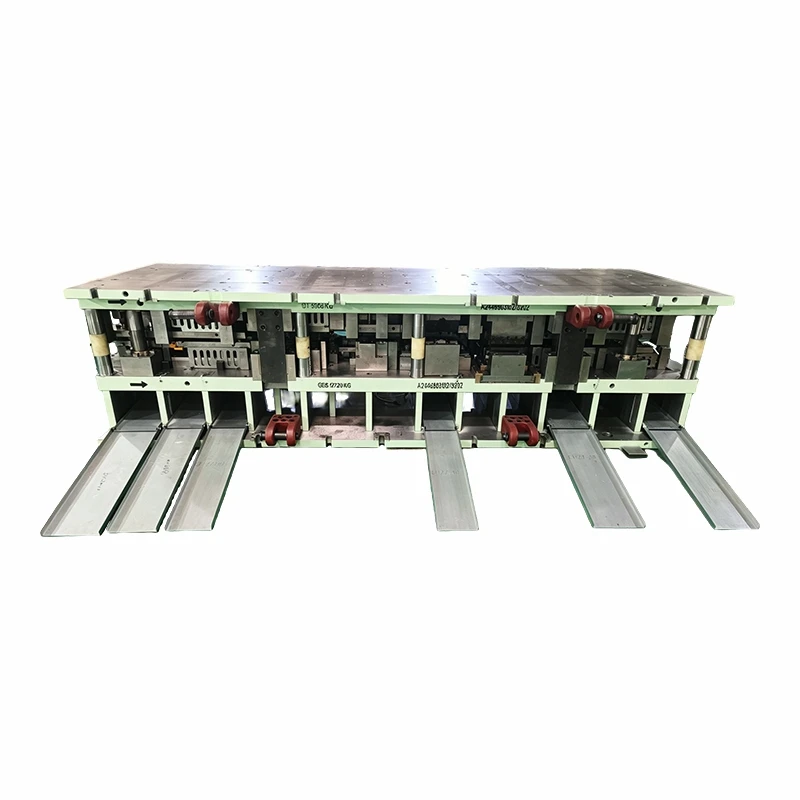
Product Parameters
|
Item |
Specification |
|
Product Name |
Automotive Press Die |
|
Part No. |
A2448803102 & A2448803202 |
|
Raw Material |
CR3-GI50/50-U |
|
Blanking Size |
1.5T x 436W x 210P mm |
|
Material Utilization Rate |
67.2% |
|
Tooling Size |
3650L x 900W x 750H mm |
|
Press Tonnage |
Main: PKZY800 / Backup: 630 T |
|
Shut Height |
800 mm |
|
Feeding Height |
410-640 mm |
|
Lower Lifting Height |
50 mm |
|
Force Data |
Cutting 128 T / Forming 170 T / Stripper 27.9 T / Total 325.9 T |

An automotive panel press die should divide cutting, forming, and stripping loads across the sequence instead of concentrating them near one end of the tool. The listed forces are 128 T for cutting, 170 T for forming, and 27.9 T for stripping. For this Automotive Press Die, those values are reviewed by station together with the center of pressure. A 67.2% material utilization rate is useful for costing, but the carrier must still support the part through pilot entry, lifting, and the final cutoff without twisting.
An automotive body press die for coated high-strength sheet needs a clear plan for material flow and springback. CAE simulation can indicate thinning, compression, and likely shape change before the working steels are finished. The same approach applies to an automotive sheet metal press die used for reinforcements or floor parts, where hole position and flange angle affect welding and assembly. An automotive forming press die should establish the main surface or profile before the final trimming line and holes are locked, otherwise downstream corrections may chase a shape that is still moving.
The 800 mm shut height and 410-640 mm feeding-height range must be checked on both the PKZY800 main press and the 630 T backup press. A car body press die also needs appropriate lifting height, bolster fit, clamping access, and clearance for feeding equipment. The Automotive Press Die structure should support the high-load stations without unnecessary weight. Replaceable trim steels, forming inserts, pilots, and wear plates simplify later maintenance, while die steel and heat-treatment hardness are selected according to each component's actual duty.
Tryout begins with station samples and a force review, then moves to dimensional checks for profile, trimming line, hole position, flange angle, burrs, and tool marks. Feed timing and lower lifting are adjusted before speed is increased. Buyers should submit a matched 2D drawing and 3D drawing set, the press specification, and die technical standards, plus the material certificate and inspection datums. That package allows the line fit, tryout plan, and spare-parts scope to be agreed before release.
Automotive Certification and Patent Basis
Automotive press die projects are normally reviewed against supplier quality systems, traceable documentation, and proven process discipline. This module can present IATF 16949, ISO 9001, export qualification records, high-tech enterprise recognition, and automotive tooling patents related to forming, cutting, lifting, or integrated die mechanisms.
The certificate content supports the technical data above by showing that the Automotive Press Die is developed within a structured manufacturing environment. It also helps purchasing and engineering teams assess whether the supplier can support automotive programs where dimensional approval, controlled changes, and repeatable tryout records are required.


Hot Tags: automotive press die, China automotive press die manufacturers, suppliers, factory


