

Metal Press Tooling Shown Through a Real Progressive Die Project
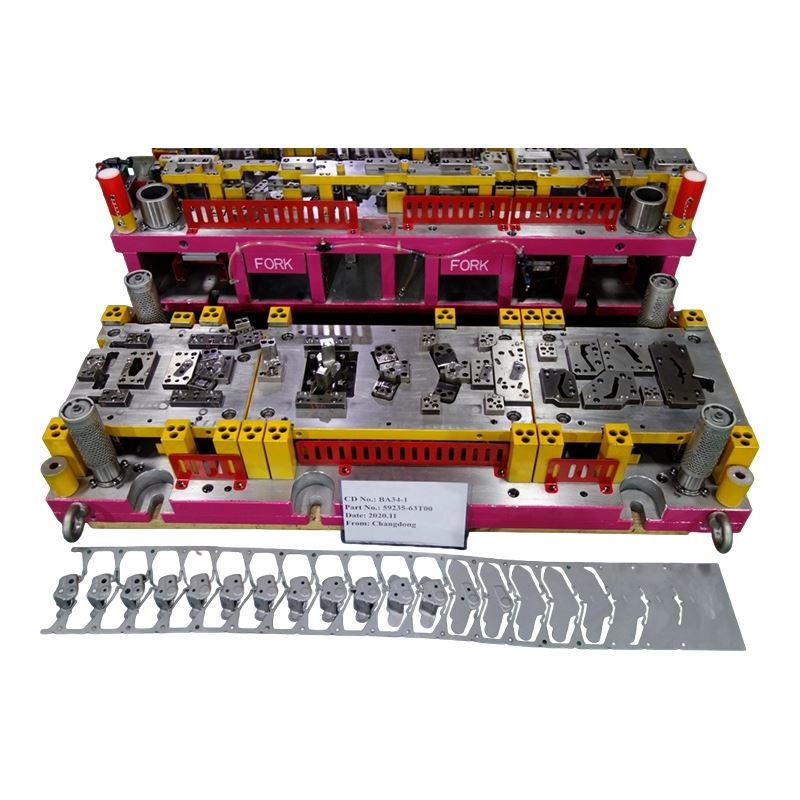
This Metal Press Tooling project is shown with three types of physical evidence: the die opened, the stamped strip removed from the tool, and the completed die in its closed condition.
Each view answers a different question. The open die exposes the internal working layout. The strip shows how the component develops from one station to the next. The closed tool shows how those individual operations are integrated into one production assembly.
For a tooling buyer, that combination provides more useful information than an exterior die photograph alone. It connects the finished tool with the process that actually produces the part.

What the Open Die Actually Shows
An operation diagram can describe the sequence, but an open die shows how much space is actually available between working areas. Cutting, locating and forming features all have to coexist inside the same structure without making later correction unnecessarily difficult.
The photograph makes it easier to see which features are local working components and which belong to the main tool structure. This is useful when evaluating how the die was designed to accommodate initial adjustment during development.
A CAD model represents design intent. The open Metal Press Tooling shows what was actually machined, assembled and fitted. For overseas sourcing, the distinction between proposal and physical result is important.
Read the Strip Before Judging the Finished Part

The strip keeps the sequence visible and shows how the part develops before final separation.
The finished component does not show how much forming was introduced early in the process. The strip does. This helps explain whether the geometry is built gradually or concentrated into only a few operations.
A hole or cut edge created early can still change position if the surrounding sheet is formed later. Its location in the strip gives engineers a clearer view of the relationship between piercing and subsequent geometry changes.
Material utilization matters, but the remaining strip also has a mechanical job. It has to support and locate the workpiece until the last required operations are complete.
The Strip Can Also Expose Process Decisions
Cut first or form first? There is no universal answer. The sequence depends on whether later material movement can change a feature that has already been cut.
How quickly is material removed? Removing too much carrier too early can make the remaining strip more sensitive to movement. Leaving too much material may increase material consumption or restrict forming.
Where is the part still connected? The connection points influence how the component is carried through the later stations and where final separation takes place.
Does the sequence make engineering sense? A useful strip should allow the customer and toolmaker to discuss the process in physical terms instead of relying only on station numbers.
Not Every Tooling Detail Can Be Proven by a Photograph
A clean-looking tool or strip cannot prove dimensional capability. Hole position, profile, trimming line and other controlled features still need to be evaluated against the released drawing and agreed inspection method.
A strip photographed after tryout does not establish the speed at which the die can run continuously. That depends on the complete press, feed and tooling condition.
The acceptance result belongs to the specific project criteria. Physical tooling photographs are project evidence, but they do not replace the sample and inspection records agreed with the customer.
Closed Tool: One Finished Assembly

The closed die shows the complete tooling assembly after the individual working stations have been integrated and fitted.
The closed view answers a different question from the strip. It shows the Metal Press Tooling as one physical production asset rather than a sequence of separate operations.
Upper and lower structures, guide arrangement and overall construction can now be viewed as one unit. This is useful when a buyer wants to compare what was described during quotation with what was eventually manufactured.
It is also why Changdong prefers to present more than one image where project records are available. Open-tool, strip and closed-tool photographs provide complementary information rather than three versions of the same evidence.
Using Previous Projects During a New Tooling Review
A similar stamped component can be useful for discussing tooling experience, but the new drawing still decides the process. Material, tolerances, press conditions and required production volume can make a visually similar part need a different strip or die structure.
Instead of saying only that Changdong makes progressive tooling, an actual open die and strip allow the buyer to ask about visible engineering choices and compare them with the requirements of the new component.
The final Metal Press Tooling concept should be based on the new part data and production conditions rather than duplicated from an earlier project simply because the geometry appears similar.
What Buyers Can Compare Before Tooling Is Awarded
|
Ask for |
Why it helps |
|
Open-die project photo |
Shows internal tooling construction rather than only the exterior assembly. |
|
Strip or intermediate process evidence |
Provides a view of how the stamping sequence was actually arranged. |
|
Closed-tool photo |
Shows the final completed die as one production assembly. |
|
Project-specific explanation |
Separates facts from that project from general factory capability statements. |
|
Acceptance criteria |
Clarifies what ultimately determines whether the new tooling is approved. |
The most useful project evidence connects the internal tool, the strip and the finished assembly. Together they allow buyers to see more of the actual work behind the die and ask more specific questions before starting a new program.
Changdong uses previous tooling projects in this way: as engineering references that support a new discussion, while the new drawing and production requirements remain the basis for the next tool.
Hot Tags: metal press tooling, China metal press tooling manufacturers, suppliers, factory, application specific stamping dies, custom compound metal stamping die, custom flanging dies, custom piercing die, custom single stage stamping die, precision stamping die


