

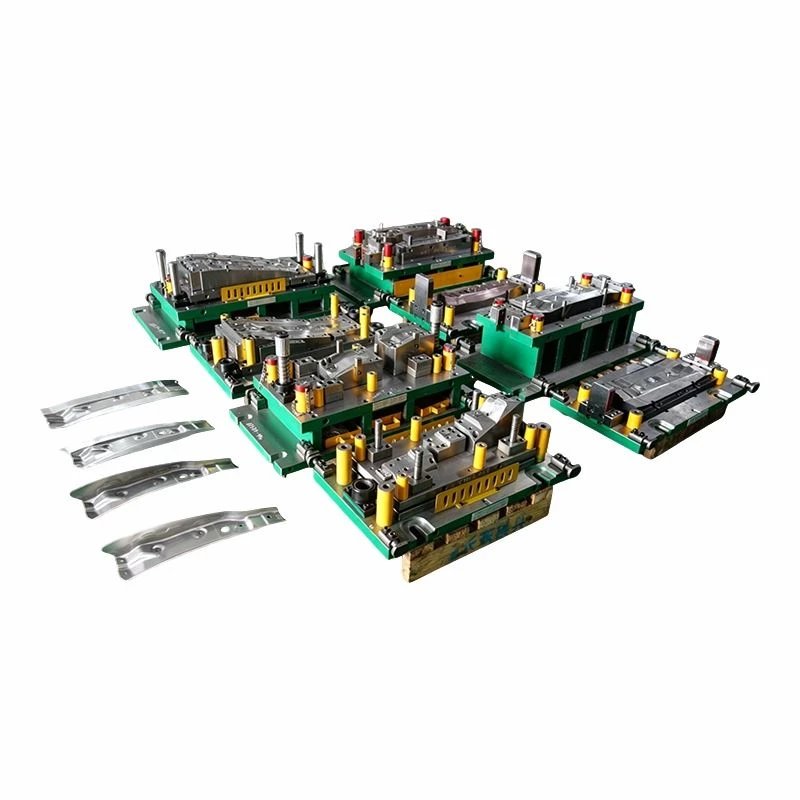
Product Parameters
|
Item |
Specification |
|
Product Name |
Sheet Metal Die |
|
Part Material |
250/450DPD+Z |
|
Thickness |
1.6 mm |
A sheet metal forming die for 250/450DPD+Z should use enough intermediate shape control to avoid forcing the final angle in one severe operation. The Sheet Metal Die process may include pre-forming, final forming, restrike, trimming, and piercing, depending on the part. Material flow near corners and flanges needs attention because a stable outer profile can still hide local strain. CAE simulation is useful when the drawing contains deep walls, reverse forms, or broad flanges, but its results must be confirmed with the supplied material data and physical samples.
A sheet metal press die must account for elastic recovery after the load is removed. Compensation can be built into the forming surface, added through restrike, or adjusted locally during tryout. The appropriate method depends on the geometry and assembly datums. For a sheet metal stamping die, cutting clearance is also important: too little clearance increases force and wear, while too much can enlarge burrs and shift the effective edge. Final hole position and trimming line should be set only after the surrounding shape has become stable.
The metal sheet forming die should use rigid support under high-load zones and replaceable inserts at trim, pierce, and heavily corrected areas. Contact surfaces for coated steel are polished and kept accessible for cleaning. Die steel and heat-treatment hardness are selected by duty rather than copied across the assembly. A sheet metal tooling die also needs practical die clamping, lifting points, sensor access, and scrap clearance. These service details affect uptime just as directly as the working geometry.
Documented Quality and Tooling Know-how
A sheet metal die supplier may need to prove both production control and technical development. The certificate display area can therefore cover ISO 9001, export operating qualification, high-tech enterprise recognition, and patents for forming, piercing, trimming, or die-positioning structures used in sheet metal stamping work.
For the Sheet Metal Die, these documents help explain how the supplier manages repeatability, engineering review, and tooling maintenance. They also provide a practical trust signal for customers who need stable springback control, protected coating surfaces, and consistent sample approval across multiple production runs.


FAQ
Hot Tags: sheet metal die, China sheet metal die manufacturers, suppliers, factory


