

If you’re running a metal stamping operation, you know that dies are the unsung heroes of your production line. They shape every part you turn out, from appliance brackets to automotive chassis components, and if you pick the wrong material, it can throw off your quality, waste tons of money, and even stall lead times. I’ve been working in metal stamping die supply for over a decade, and I’ve seen way too many clients cut corners on die materials just to save a buck—only to end up with more scrap, more machine downtime, and way higher costs in the long run. Today, let’s break down how die material selection actually impacts stamping quality and your bottom line, no jargon, no fluff, just real talk from someone who’s stood on the shop floor watching these choices play out.
First, let’s start with the basics: what do dies do, and why does their material matter? Stamping dies have to punch, bend, and form metal sheets (usually steel, aluminum, or copper) thousands, even hundreds of thousands of times. They take a beating—constant friction, high pressure, and sometimes heat from the work material. If the die material is too soft, it’ll wear out fast, cause uneven part shapes, or even chip mid-run. If it’s too hard but brittle, it might crack or break, leading to unplanned stops. The sweet spot here depends on your part type, production volume, and metal grade. That’s where knowing your options and their tradeoffs comes in.
Let’s talk quality first, because that’s what keeps your customers coming back. Poor die material leads to two big quality headaches: dimensional inconsistency and surface defects. Take surface defects, for example. When a die wears, its surface gets rough, or it develops micro-burrs from friction. Those imperfections transfer straight to your stamped parts—think scuffs on appliance panels (your appliance stamping die is a perfect example here, since appliance parts demand smooth, blemish-free finishes to pass QA). I had a client a couple years back who used a low-grade tool steel for their appliance door frame dies. After only 5,000 runs, the die’s surface had worn enough to leave fine scratches on every frame. They ended up with 12% scrap rate, rework costs of $1.2k a week, and a customer threatening to switch to a competitor. Swapping to a proper die steel cut the scrap to less than 1% and eliminated the rework entirely—they even ended up increasing their production run by 3x without quality issues.
Then there’s dimensional accuracy, which is make-or-break for parts that fit together, like automotive transmission components or electrical connectors. Dies that wear unevenly will produce parts that are slightly off-spec—maybe a bend angle is 2 degrees too shallow, or a hole is 0.5mm too small. For high-volume jobs, that adds up fast. I’ve seen a progressive press tool using a cheap die material produce parts that were within tolerance for the first 10,000 runs, then slowly drift, leading to a batch of 20,000 parts that were all too wide. The client had to scrap the whole batch, costing them $8k in materials and labor, plus a rush order to fix their customer’s line. If they’d invested in a die material with better wear resistance (like D2 tool steel, or even powdered metal steel for super high volume), that drift would’ve happened later—if at all.
Now let’s tie that to cost, because this isn’t just about quality; it’s about your profit margin. There are two types of cost when it comes to dies: upfront material cost and hidden long-term costs. The mistake I see most often is focusing only on the upfront price tag, not the total cost over the die’s lifespan. Let’s break it down with numbers. Suppose you need a die for a 100,000-run job. Option 1: low-grade tool steel, $1,200 upfront, lasts 50,000 runs, so you’ll need two dies for the job. That’s $2,400 total material cost, plus $1,500 in downtime for changing dies, $2,000 in scrap from worn dies. Total: $5,900. Option 2: mid-grade tool steel, $2,000 upfront, lasts 120,000 runs, so one die works, $500 in downtime, $300 in scrap. Total: $2,800. That’s a $3,100 difference—all because of die material. For a progressive die tooling (which runs multiple operations in one stroke), the material impact is even bigger because those dies do multiple jobs at once. Wear on one station can mess up the whole run, leading to way more downtime than a single-operation die.
Wait, but what about super high-volume jobs? Like, say, a progressive press tool running aluminum can lids, with a million runs. You can’t use mid-grade steel here—you need something like carbide, which is way harder, way more wear-resistant, even if it’s 5x the upfront cost. Let’s do the math there: carbide die, $10,000 upfront, lasts 1.5 million runs, almost no downtime. Total cost over the job: $10,000. If you used mid-grade steel, you’d go through 12 dies at $2,000 each: $24,000, plus 12x $500 downtime = $6,000, plus $1,500 scrap = $1,500. Total: $31,500. That’s a $21,500 difference. For that kind of volume, investing in the right die material isn’t just smart—it’s necessary to stay competitive.
But it’s not just volume; part complexity and the type of metal you’re stamping matter too. If you’re stamping thick, high-tensile steel (like for agricultural equipment parts), you need a die material with high toughness to handle the pressure without cracking. Carbide might be too brittle here—even if it’s hard, it can snap under the heavy loads of thick steel. Instead, you’d go with a tool steel like A2, which balances hardness and toughness. On the flip side, if you’re stamping thin, soft aluminum (for consumer electronics), you might not need super hard carbide—A2 or even O1 tool steel would work, cutting your upfront cost without sacrificing quality.
Another factor I see clients miss: maintenance. Die materials that have good machinability (like O1 tool steel) are way easier to grind, repair, or modify if a part design changes. If you use a super hard material like carbide, repairing a die is way more expensive—you might have to replace the whole insert instead of just grinding down a worn area. So if you’re not sure if your part design will stay the same for years, a machinable die material can save you on adjustments. That’s why for custom jobs, a lot of clients go with metal press tooling with O1 or A2 steel, since it’s flexible for tweaks without breaking the bank.
Let’s circle back to real examples from our work. Last quarter, we had two clients: one making HVAC brackets, another making automotive seat components. The HVAC client was running 50,000 runs a year with 16-gauge steel. They came to us wanting to switch to a cheaper die material to cut costs. We talked them through their production volume and part requirements—they didn’t need carbide, but O1 steel would give them 80,000 runs per die, way more than their current 30,000 runs with low-grade steel. They ended up going with O1, cut their material cost by 20% (since O1 is cheaper than D2), reduced scrap by 7%, and only needed one die a year instead of two. The automotive seat client, though, was running 300,000 runs a year with 12-gauge high-tensile steel. We recommended D2 tool steel, which has the toughness to handle the high pressure and wear resistance to last 150,000 runs per die. They tried a low-grade steel first, and after 25,000 runs, the die started chipping, leading to a $3k scrapped batch. Swapping to D2 fixed that, and now their downtime is down 40%.
The big takeaway here is that die material selection isn’t a one-size-fits-all call. It’s a balance between upfront cost, production volume, part complexity, metal grade, and your tolerance for risk. Cutting corners on material might save you a little now, but it’s going to hurt you later with scrap, downtime, and lost customers. Investing in the right material fits your specific needs will keep your parts consistent, scrap low, and your production running smooth.
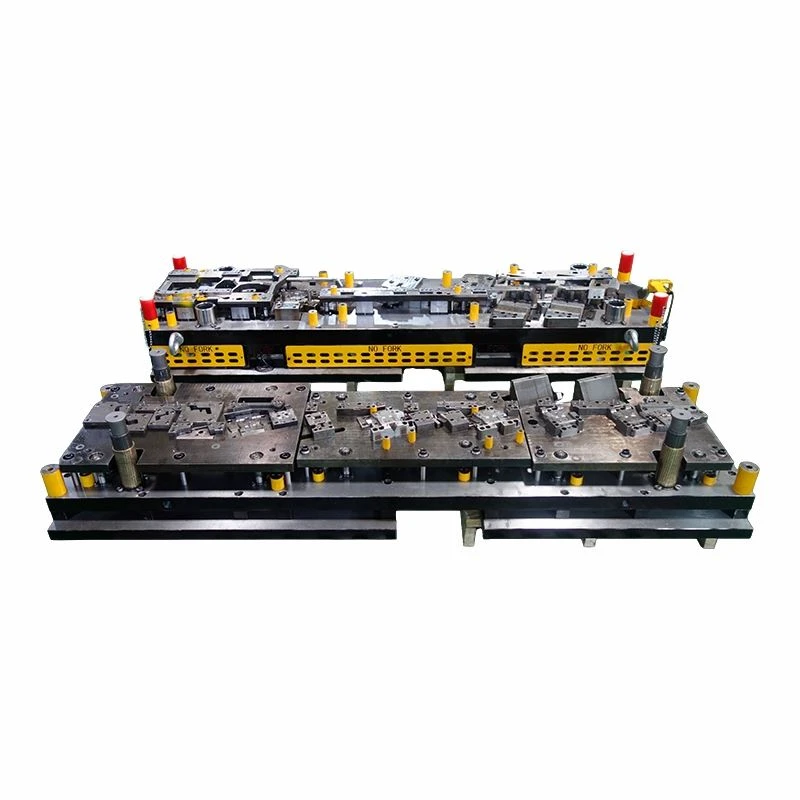

If you’re not sure what material is right for your stamping job—whether it’s appliance parts, progressive dies, or custom press tooling—we’re here to help. We work with all die materials, from standard tool steels to super-hard carbides, and can walk you through the math to find the sweet spot for quality and cost. Reach out to us to talk through your project details, and we’ll put together a die solution that works for your needs.
References
- Smith, J. (2021). Die Material Selection for Metal Stamping Operations. Journal of Manufacturing Processes, 62, 412-425.
- American Metal Stamping Association. (2022). Best Practices for Press Tooling and Die Material Cost Analysis. AMBA Technical Report Series.
- Lee, S., & Park, H. (2020). Wear Behavior of Stamping Die Materials for High-Volume Production. International Journal of Machine Tools and Manufacture, 158, 103672.
- Progressive Tooling Association. (2023). Progressive Die Material Guidelines for Automotive and Appliance Stamping. Tooling Industry Journal.