

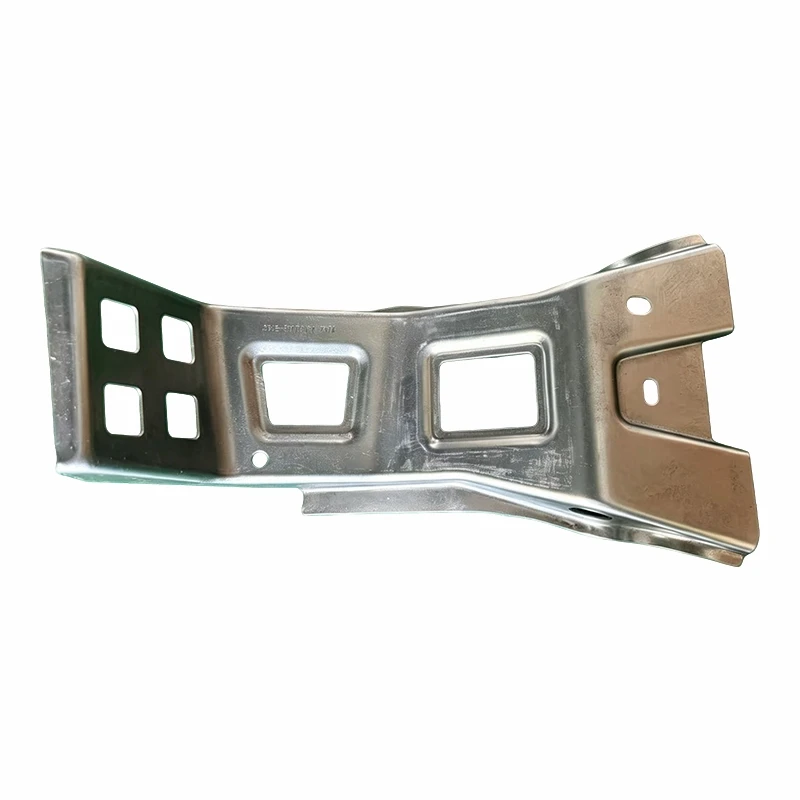
Automotive Brackets Produced Through a 7-Operation Stamping Route
Changdong produces these Automotive Brackets from 1.5 mm DC01 sheet through seven defined stamping operations.
The tooling is more compact than the OP count suggests. OP10, OP20 and OP30 use individual dies, while OP40–50 and OP60–70 are grouped into combined tooling stages. Seven process conditions are therefore completed with five physical die sets.
The project photos show both the intermediate samples and all five tooling groups, making the actual production route visible rather than reducing the job to a generic single-stage stamping description.

Product Parameters
|
Item |
Specification |
|
Product Name |
Automotive Brackets |
|
Part Material |
DC01 |
|
Material Thickness |
1.5 mm |
|
Blank Size |
1.5T × 211W × 364P mm |
|
Process Route |
OP10 / OP20 / OP30 / OP40 / OP50 / OP60 / OP70 |
|
Physical Tool Sets |
5 Die Sets |
|
Output |
1 Part per Cycle |
|
Changdong Scope |
Tooling / Stamping / Inspection / Production Support |
Seven Operations, Five Physical Die Sets
This project is a useful example of why OP quantity and tool quantity do not always need to be identical.
Changdong uses individual dies for OP10, OP20 and OP30. Later in the route, OP40–50 share one tooling group and OP60–70 share another.
We combine consecutive operations only when doing so keeps the tool practical for loading, fitting, correction and later maintenance. Adding another complete die simply to match an OP number would increase tooling and setup without necessarily improving the stamped part.
The seven intermediate samples are still kept identifiable even though the physical tooling is reduced to five sets.
Three Independent Dies at the Front of the Route

OP10
First independent die in the seven-operation stamping route.

OP30
Third independent die before the route moves into combined tooling stages.
The starting blank is 1.5 mm DC01 at 211 × 364 mm. The first three operations remain physically independent, giving our production and toolmaking teams direct access to each die during setup or maintenance.
We do not assign a cutting or forming function from the OP number alone; the exact operation remains tied to the released process data.
OP20 Is Shown at a Smaller Scale for Better Page Balance
OP20 also uses an independent die set. Keeping it separate makes the physical tool easier to access during fitting and repeat production.
This project photo is portrait-oriented, so we display it beside the text rather than stretching it across the full content width.
That keeps the actual tooling visible without allowing one vertically oriented photograph to dominate the page.
From a production standpoint, OP20 remains part of the same controlled seven-operation route and keeps its own setup and maintenance identity.

Later Operations Are Combined Into Two Tooling Groups

OP40–OP50
Two process conditions completed within the fourth physical die set.

OP60–OP70
The fifth die set completes the seven-operation production route.
The two combined tool sets show why the project can maintain seven distinct process conditions with only five physical dies.
For Changdong, combining operations is worthwhile only when the working areas remain accessible and a local repair does not require unnecessary work on the rest of the die.
Once OP60–70 is complete, the acceptance focus moves to the finished bracket rather than the complexity of the tooling route behind it.
The Bracket Is Approved by Its Assembly Features
Hole and slot locations are reviewed against the functional datums used by the mating automotive structure, not only as isolated drawing dimensions.
Flanges that affect welding, fastening or final installation are checked after the complete stamping route and after the part has been released from the die.
Where another vehicle component rests against the bracket, local profile and surface position can carry more functional importance than a noncritical cosmetic area.
Changdong Owns the Five Tooling Sets Behind the Parts
Changdong designs and manufactures stamping dies as well as supplying finished Automotive Brackets.
The five physical tools remain under the same manufacturing system as the stamped-part production. When one tool is serviced, our team knows which OP conditions are associated with that hardware and which first-off results deserve additional attention afterward.
Our Dongguan tooling operation supports design review, CNC machining, WEDM, EDM, grinding, drilling, fitting and press tryout.
This gives the customer one production supplier with direct control over the tooling used behind the finished bracket.
Repeat Production Uses an Existing Baseline
Once the seven-operation route reaches an approved condition, the five die sets and approved part provide the baseline for later production batches.
If one tooling group has been repaired or adjusted, Changdong can focus first-off checks around the relevant part of the route and then confirm the finished bracket before regular production continues.
The customer therefore receives repeat Automotive Brackets from a known tooling and manufacturing condition rather than restarting the project logic with every new order.
Hot Tags: automotive brackets, China automotive brackets manufacturers, suppliers, factory, automotive chassis stamped parts, automotive structural stamping parts, electric vehicle stamped brackets, ev battery housing stamped parts, ev battery pack stamped parts, ev metal brackets


