

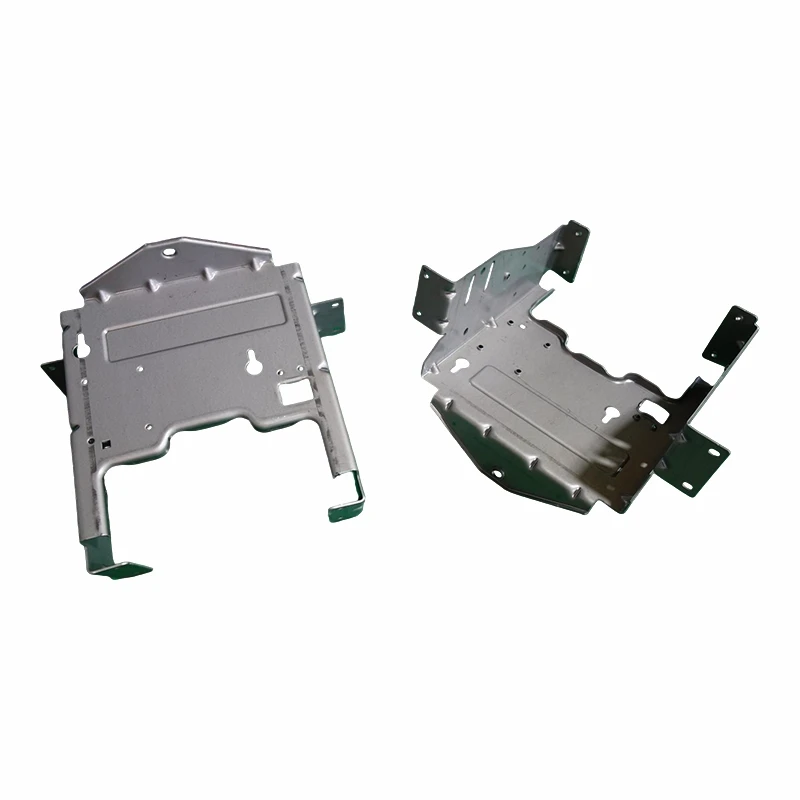
Battery Enclosure Stamping Parts for Draw Bar Production
Changdong produces these Battery Enclosure Stamping Parts as Draw Bar components from ASTM A1011-02 DS Type B pickled-and-oiled steel with a minimum thickness of 2.66 mm.
The part is manufactured through an 8-step progressive stamping process with one finished component per stroke. The tooling behind the production is substantial: approximately 3780L × 1250W × 750H mm and 13.6T.
For the customer, the deliverable is the stamped component. For Changdong, the tooling, press setup, production result and final packing all belong to the same manufacturing program.

Product Parameters
|
Item |
Specification |
|
Product Name |
Battery Enclosure Stamping Parts |
|
Part |
Draw Bar |
|
Part Material |
ASTM A1011-02 DS Type B, Pickled and Oiled |
|
Material Thickness |
2.66 mm Minimum |
|
Blank Size / Pitch |
2.66T × 660W × 450P mm |
|
Tooling / Process |
Progressive Die, 8 Steps |
|
Output |
1 Out per Stroke |
|
Tooling Size |
3780L × 1250W × 750H mm |
|
Tool Weight |
13.6T |
2.66 mm Steel Makes This a Heavy Stamping Program
This is not a thin cosmetic cover stamping. The starting material is at least 2.66 mm thick, with a strip width of 660 mm and a 450 mm progression.
That combination creates meaningful cutting and forming load throughout the tool. The carrier has to remain strong enough to move the workpiece through the complete 8-step route without becoming unstable after earlier material has been removed.
For production, we are interested in more than whether the press can make one acceptable stroke. Feeding resistance, strip position, finished geometry and cutting condition need to remain stable as the tool continues running.
The pickled-and-oiled surface also requires controlled handling after stamping so unnecessary scratches, contamination or corrosion exposure are not introduced between production and packing.
Behind the Part Is a 13.6T Progressive Tool
The die measures approximately 3.78 meters long and weighs 13.6T. That tooling scale matters directly to the stamped-parts supply program.
A long, heavy tool has to maintain alignment across the complete working length while cutting and forming loads occur at different positions inside the die. Tool support, guidance and the press interface therefore affect the condition of the finished component.
Changdong builds stamping dies in-house, so this tool is not an external production asset that we can only operate but cannot modify.
If the production result begins to move, our tooling team has direct access to the same die used for these Battery Enclosure Stamping Parts.

Eight Steps Give the Part Room to Develop
The 8-step route allows the work to be divided instead of forcing heavy cutting and forming activity into only a few crowded stages.
For Changdong, the value of those steps is process control. Features can be created when the surrounding geometry is sufficiently stable, and heavy work can be distributed along the tooling instead of concentrating the complete load in one area.
We do not assign generic functions to an OP number without the released project data. What matters for production is that each step leaves the strip in a condition the following step can use consistently.
The final part is judged after the complete route, because an acceptable intermediate condition has value only if it contributes to a stable finished Draw Bar.
The Tool Has to Work on the Press, Not Only on the Fitting Floor
The press-mounted photograph is an important part of this project because it shows the die under the condition that actually produces the parts.
At 3780 × 1250 × 750 mm and 13.6T, press fit involves more than nominal tonnage. The tool needs physical support, workable clamping positions and correct alignment with the feeding system.
During production review, we also watch what happens after repeated strokes. A strip that feeds smoothly at low speed can behave differently once cutting load, lubrication and scrap accumulation begin repeating continuously.
Changdong's in-house press capability allows tooling feedback to remain connected with fitting and machining instead of treating stamping as a separate outsourced process.

What We Control on the Finished Draw Bar
The finished component is checked against the released dimensional requirements rather than judged only by the apparent condition of the strip inside the tool.
Pierced and trimmed features are monitored for location, burr condition and repeatability where they affect the customer's subsequent joining or assembly process.
The pickled-and-oiled steel is handled so unnecessary scratches and contamination are not added after the part has already passed stamping inspection.
Tooling Maintenance Stays Behind the Parts Supply
A 13.6T production tool is a long-term manufacturing asset. Cutting inserts, guide components and other wear areas will eventually require normal service.
Because Changdong manufactures the tooling, our stamped-parts customers do not need to coordinate independently with another toolmaker every time production feedback points back to the die.
The relevant component can be inspected, serviced and returned to production under the same project data. New first-off parts are then checked before normal batch production continues.
This keeps tooling maintenance in the background of the supply program instead of turning every normal service event into a separate customer-managed project.
Completed Tooling Behind Regular Production

Completed progressive tooling: approximately 3780 × 1250 × 750 mm and 13.6T.
Packing Is Part of the Delivered Part Condition
Inspection is not useful if the approved part is damaged between the stamping area and the customer's plant.
The packed-parts photograph at the top of this page represents the final stage of the manufacturing route. After stamping and inspection, the Draw Bar components still need controlled stacking and protection appropriate for their geometry and surface condition.
For repeat supply, packing requirements can remain tied to the same part specification so later batches do not leave Changdong under a different handling condition from the approved shipment.
This is how we approach ongoing Battery Enclosure Stamping Parts production: tool build, press production, inspection and packing remain connected until the finished parts are ready to ship.
Hot Tags: battery enclosure stamping parts, China battery enclosure stamping parts manufacturers, suppliers, factory, automotive chassis stamped parts, automotive deep drawn parts, automotive heat shield stamping parts, deep drawn components, ev battery housing stamped parts, ev sheet metal stamping parts


