

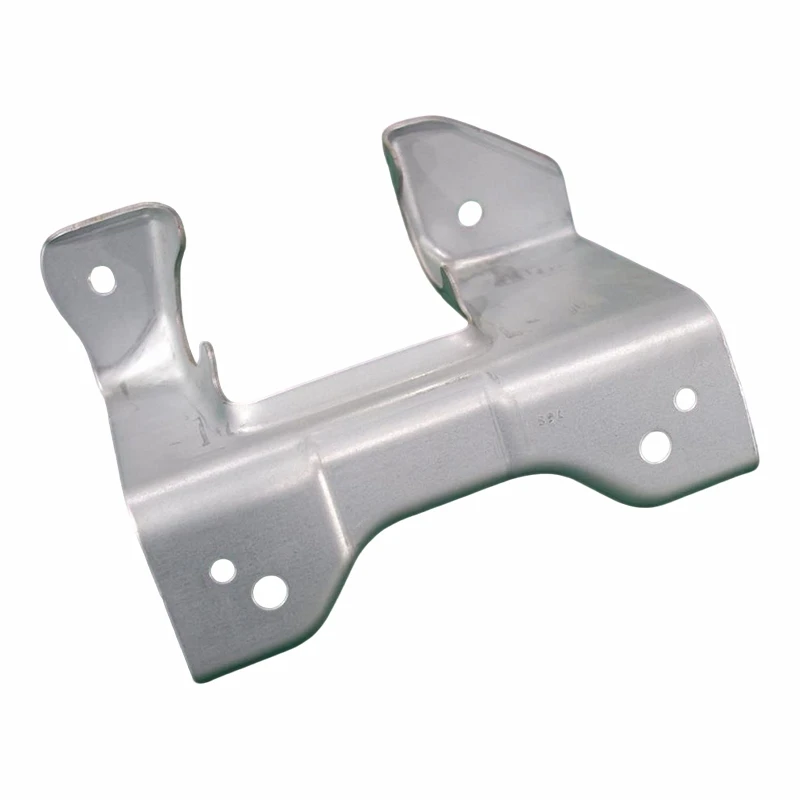
Automotive Stamped Parts from 14-Station Progressive Production
These Automotive Stamped Parts are produced from 1.8 mm JIC270CN-45/45 sheet through a 14-station progressive stamping process.
The strip reference is 1.8T × 230W × 210P, with one finished part produced per stroke. Instead of concentrating all forming and cutting work into only a few heavy steps, the 14-station route gives the part enough process length for geometry, holes, edges and flanges to be developed in a controlled sequence.
Changdong can support both the tooling and the stamped-part production. That gives us direct control over the relationship between the die condition and the final part instead of separating tool correction from production feedback.

Product Parameters
|
Item |
Specification |
|
Product Name |
Automotive Stamped Parts |
|
Part Material |
JIC270CN-45/45 |
|
Material Thickness |
1.8 mm |
|
Blank Size / Pitch |
1.8T × 230W × 210P |
|
Tooling / Process |
Progressive Die, 14 Stations |
|
Output |
1 Out per Stroke |
|
Production Support |
Tooling + Stamping + Inspection |
The Finished Part Is What We Control
For stamped-part production, the customer is not buying a strip layout or a die assembly. The customer is buying a component that has to fit the next welding, fastening or assembly process.
That changes how we look at production. A hole is not considered correct only because the punch is in the right position. Its final relationship to the part datum still has to remain correct after the later forming stations.
The same applies to flange angle, local profile and trimmed edges. We inspect the finished condition rather than treating each operation as an isolated success.
This is the main difference between supplying tooling and supplying stamped parts: the output of the complete process becomes our responsibility.
Why This Part Uses a 14-Station Progressive Process
A longer progressive route gives us room to separate operations that would interfere with each other if they were forced into fewer stations.
Piercing, trimming, bending and forming can be positioned according to when the part geometry is stable enough for each feature. This is particularly useful when a hole needs to remain accurate after nearby material has moved through later forming work.
The carrier also has to stay strong enough to move the part through all 14 stations. Material utilization matters, but we do not reduce carrier support to the point where feeding accuracy and final part consistency become harder to control.
For these Automotive Stamped Parts, the 14-station route is therefore part of the production-control strategy rather than simply a more complicated die layout.
We Watch the Features That Affect Assembly
Critical holes are checked against the final datum condition. If later forming changes the surrounding geometry, we look at the complete process before moving a piercing feature.
Flange angle and local profile are checked after the part is released from the die. This is the condition that will enter the customer's assembly process.
Edge quality is monitored where burr direction, sharp edges or local trim variation could affect handling, joining or downstream assembly.
Making the Tool In-House Helps Us Control the Parts
Changdong is not only a stamping-parts processor. We also design and manufacture the dies used to make those parts.
If production samples begin showing a dimensional change, burr growth or a local forming issue, our team can inspect both the part and the tooling condition. We do not have to send the problem back to a separate die supplier before deciding what should be changed.
Our Dongguan tooling facility includes 13 die design engineers, CNC machining, a 3-meter gantry CNC, six WEDM machines, EDM, grinding, high-speed drilling, fitting and press tryout capability.
For stamped-part customers, the value is straightforward: the people responsible for the production result also have direct access to the tooling that creates it.
Production Stability Is Checked Across Consecutive Strokes
One acceptable first-off sample does not establish a stable production process.
During production review, we compare consecutive parts to see whether hole position, flange angle, profile and edge condition remain consistent as the tool continues cycling.
This also helps us distinguish normal part variation from a tooling condition that is beginning to change. Burr growth may point to cutting wear. A gradual profile change may lead us toward a forming or pressure condition instead.
For Automotive Stamped Parts, repeatability across the run matters more than producing one especially good sample for approval.
Material and Tooling Condition Stay Connected
The approved process for this part is based on 1.8 mm JIC270CN-45/45 material.
When material condition changes within the approved specification, the part can still respond slightly differently through the forming stations. We therefore do not assume that every dimensional change is automatically a die problem.
Production records help us compare material condition, stamped samples and tooling status before making a correction.
This is especially useful for long-running automotive programs, where tooling wear and material-lot variation can otherwise look very similar in the final part.
From Approved Sample to Repeat Production
Once the part reaches the agreed condition, we keep that sample and its production setup as a reference for later runs.
If a wear component is serviced or the die requires adjustment, new first-off parts can be compared against a known approved baseline instead of relying only on memory or visual judgment.
Changdong can support tooling correction, sample stamping and continued part production within the same manufacturing operation.
For customers sourcing Automotive Stamped Parts, this gives a more direct connection between the approved component and the tooling condition used to produce it.
Hot Tags: automotive stamped parts, China automotive stamped parts manufacturers, suppliers, factory, automotive chassis stamped parts, automotive deep drawn parts, automotive stamped contacts, brass stamping parts, electric vehicle stamped brackets, progressive metal stamping components


