

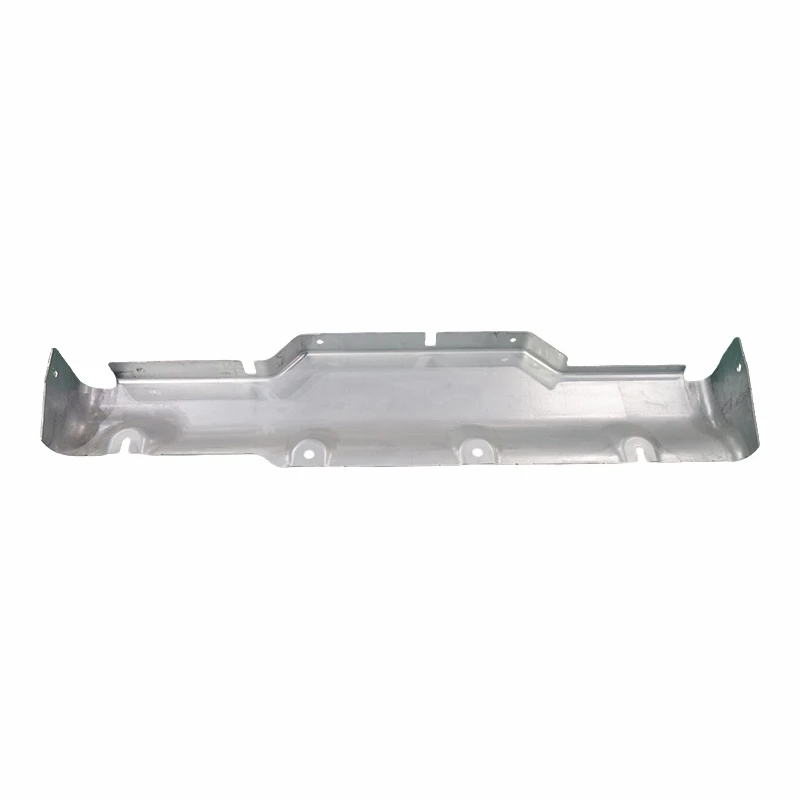
Vehicle Metal Stamped Components From an 11-Station Progressive Process
Changdong produces these Vehicle Metal Stamped Components from 1.0 mm JAC270CU45/45 sheet using an 11-station progressive stamping die.
The production strip is 810 mm wide with a 205 mm pitch, and one finished component is produced per stroke. At this width, the process depends on more than individual cutting or forming actions; the complete strip has to feed consistently across the working area of the tool.
The open-die photograph shows the actual tooling behind the component supply. For the customer, the deliverable is the stamped part. For Changdong, the strip, tool, press condition and finished result remain part of one production system.

Product Parameters
|
Item |
Specification |
|
Product Name |
Vehicle Metal Stamped Components |
|
Part Material |
JAC270CU45/45 |
|
Material Thickness |
1.0 mm |
|
Strip Width / Pitch |
1.0T × 810W × 205P mm |
|
Tooling / Process |
Progressive Die, 11 Stations |
|
Output |
1 Part per Stroke |
|
Changdong Scope |
Tooling / Stamping / Inspection / Production Support |
The 810 mm Strip Width Defines the Production Condition
An 810 mm wide strip behaves differently from a narrow coil-fed part.
The material has to remain supported across a larger width while it advances through an 11-station tool. If one side begins feeding differently from the other, the strip can enter later stations under a different condition even when the nominal pitch still appears correct.
For production, we therefore pay attention to how the complete strip travels through the die rather than looking only at one pilot or one local feature.
This is especially important during longer runs, when small changes in feeding resistance, lubrication or scrap condition can become more visible than they are during a few isolated trial strokes.
Eleven Stations Are Used to Control the Finished Part, Not to Add Complexity
The purpose of an 11-station route is not simply to make the tooling look more sophisticated.
Additional stations give the process room to separate work that should not be concentrated into the same area of the strip. They also allow the component geometry to develop while the carrier continues supporting the part until final separation.
The exact function of each station follows the released strip layout and part drawing. We do not assign generic piercing, trimming or forming functions to a station unless they are confirmed by the project data.
For Vehicle Metal Stamped Components, the real measure of the process is whether the finished part remains consistent as the strip continues advancing stroke after stroke.
One Part per Stroke Makes Process Drift Visible Quickly
Features are evaluated against the released datums so a gradual change in strip position does not remain hidden until the component reaches the customer's assembly process.
Repeated cutting strokes make wear trends easier to see. Burr growth or an edge change can indicate that a cutting component needs attention before the complete batch is affected.
Consecutive parts are more informative than one selected sample because continuous production needs to remain stable over the run, not only at the first accepted stroke.
The Closed Tool Represents the Condition Used for Production
The closed-die photograph shows the complete progressive tool as a production asset rather than only the internal working layout.
Once the tool is installed and running, alignment, feeding, scrap discharge and repeated opening and closing all affect the result delivered at the end of the strip.
Changdong manufactures progressive dies in-house, so production feedback does not stop at the press operator. When a part issue is genuinely related to the tooling, the same tool can return directly to our engineering and toolmaking team for inspection and correction.
That link between toolmaking and stamping is particularly useful for long-running progressive programs where normal wear eventually becomes part of production planning.

Continuous Production Is Different From a Successful Tryout Stroke
A tool can produce a good sample during slow tryout and still need further work before it is ready for normal production.
During a continuous run, scrap keeps accumulating, cutting edges repeat the same work, lubrication changes across the strip and the feeding system continues cycling without manual repositioning.
Changdong therefore looks at the process after multiple consecutive strokes rather than accepting the tooling condition from one or two visually good parts.
Parts taken from different points in the run can then be compared for the characteristics defined by the drawing, giving a more useful indication of production stability.
The Tooling Is Maintained as Part of the Parts Supply Program
For stamped-part customers, normal tooling maintenance should stay behind the production program rather than becoming a separate sourcing project.
When wear appears in a punch, insert or another working component, Changdong can inspect the relevant tooling area, carry out the required service and then confirm the first-off parts before regular production resumes.
Because the die was developed within the same manufacturing operation, the production team has access to the tooling information needed for later maintenance instead of treating the tool as a black box supplied by another company.
This keeps the physical condition of the die connected to the stamped component throughout its production life.
From 810 mm Strip to Repeat Component Supply
The customer ultimately buys the finished component, not the complexity of the 11-station tool behind it.
Changdong keeps the strip condition, progressive tooling, production run and part inspection connected so later batches can return to an established manufacturing condition.
If the tool has been serviced between orders, first-off production can be checked before normal quantity is released again.
This supports ongoing Vehicle Metal Stamped Components supply with the tooling and stamped-part production managed under the same project history.
Hot Tags: vehicle metal stamped components, China vehicle metal stamped components manufacturers, suppliers, factory, automotive heat shield stamping parts, automotive structural stamping parts, deep drawn components, electric vehicle stamped brackets, ev battery pack stamped parts, ev metal brackets


