

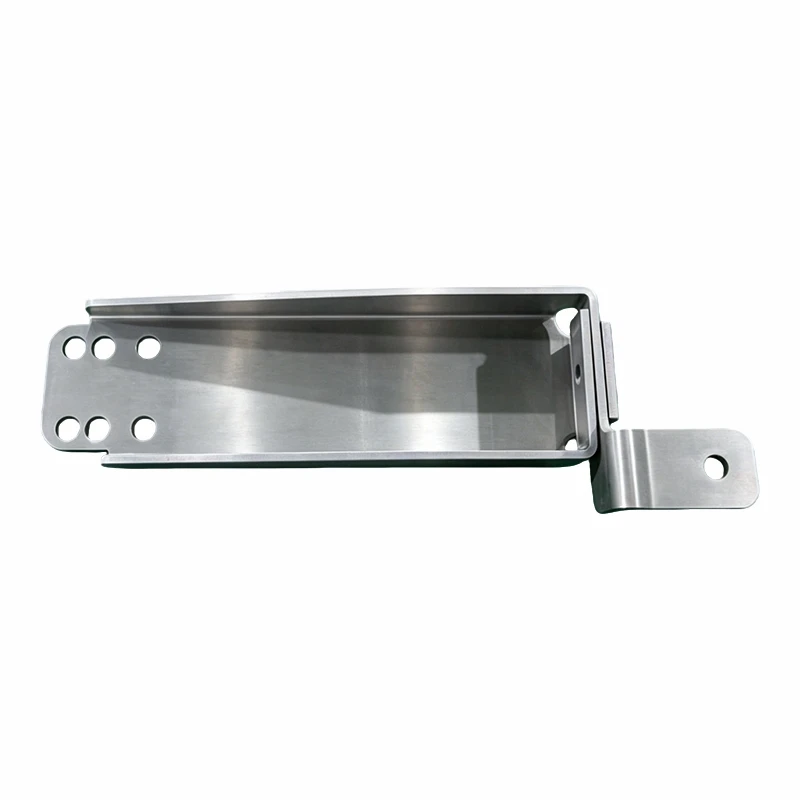
Sheet Metal Stamping Part
This Sheet Metal Stamping Part is a bumper reinforcement bracket made from 5.0 mm S275JR steel.
At this thickness, the job no longer behaves like a light sheet-metal bracket. The blank is heavier, each pierced feature removes more material, cutting sections see a higher load, and the finished component itself needs more deliberate handling between the press and the next operation.
Changdong reviews the bracket as a heavy-gauge production part. The objective is to obtain the released mounting geometry and edge condition without creating an unnecessarily complicated manufacturing route around it.
Product Parameters
|
Item |
Specification |
|
Product Name |
Sheet Metal Stamping Part |
|
Application |
Bumper Reinforcement Bracket |
|
Part Material |
S275JR |
|
Thickness |
5.0 mm |
|
Part Category |
Heavy-Gauge Automotive Bracket |
|
Manufacturing Basis |
Customer Drawing / Material Specification / Required Production Quantity |
|
Changdong Scope |
Tooling Development / Trial Stamping / Inspection / Bracket Production |
Five Millimeters Changes the Job
We do not scale a thin-sheet process up and assume it will behave the same way on 5.0 mm S275JR.
A pierced hole removes a much heavier slug. The cutting section sees more load. A trimmed edge contains considerably more material than the edge on a 0.8 or 1.0 mm component. The part is also much less forgiving when it is loaded into the wrong position.
That changes several practical decisions around the bracket.
Cutting features need enough support. The blank has to sit consistently before the press closes. Where several high-load features are located on one side of the tool, the resulting load distribution has to be considered instead of looking only at the total calculated tonnage.
The finished edge gets attention as well. A 5.0 mm cut surface is a real part of the bracket, not a thin line around its outline. Burr, edge tearing or local deformation can become relevant where the edge sits near another assembly feature.
We follow the customer drawing for acceptance. We do not add machining-style edge requirements to every stamped surface simply because the material is thick.
Press Selection Is More Than a Tonnage Number
Heavy-gauge work is one place where the press discussion becomes quite practical.
A calculated load can tell us whether a press has enough nominal capacity. It does not by itself tell us whether the physical die fits the bolster, whether the required shut height is available, or whether the working load is distributed sensibly through the stroke.
Changdong has presses from 45T to 800T, including 400T and 800T equipment for larger-load tooling. We still select the press from the actual project rather than assigning a machine only because 800T happens to be available.
For a 5.0 mm bracket, we look at the real cutting and forming requirement, die size and operating condition together.
This matters during sample development too. If a heavy tool is tried in a press condition that does not represent the intended production environment, some of the resulting behavior may belong to the setup rather than to the part design.
Where the tooling will eventually run at a customer's plant, the receiving press information should be supplied before the die structure is finalized.
The Slug Is Small Scrap, but It Is Not Light Scrap
Scrap handling becomes more noticeable when every offcut is 5.0 mm thick.
A thin slug may fall away with very little energy. A thick S275JR slug has more weight and can behave differently if the opening below it is too narrow or the path changes direction abruptly.
We want scrap to leave the working area rather than remain close to the next press stroke.
The solution depends on the real scrap shape. A large offcut may need a direct chute and suitable bin space. Smaller heavy slugs need enough clearance to fall without bridging. Where a vibrator is genuinely useful, it can be considered; where gravity already works reliably, extra equipment only creates another item to maintain.
The same principle applies to finished-part dropping off.
A heavy bracket does not need to fall onto a functional flange or another finished component simply because the press has finished its work. The route out of the tool is part of production planning.
How the Bracket Is Picked Up Matters
This is an ordinary production question that is easy to overlook while everyone is concentrating on the die.
Once a thick bracket becomes an independent part, someone or something has to move it.
If the process is manual, operators need a practical place to handle the component. If the route uses automation, the gripper needs an area that can actually be reached without interfering with the next nest or damaging a controlled surface.
We do not invent lifting holes or gripping features that are not on the customer product.
Instead, Changdong looks at the existing geometry and how the production route can use it safely.
Grabbing a mounting flange every cycle may not make sense if that flange is one of the features the customer controls tightly. The same applies to placing one heavy finished bracket directly onto another where a formed area carries the stack weight.
For a thick Sheet Metal Stamping Part, handling can be a relatively small part of the cycle time and still have a large effect on the condition of the delivered component.
When Stamping Makes Sense for a Heavy Bracket
A 5.0 mm steel component can be manufactured in more than one way during different stages of a vehicle program.
For early development or very small quantities, the customer may not need the same production investment required for a repeat-volume stamping program.
Once volume increases, dedicated tooling starts to offer a different advantage: the holes, formed areas and outside profile can be repeated from the same controlled process rather than rebuilt individually on every part.
That is the context in which Changdong reviews a production stamping project.
We do not use the part thickness by itself to justify a complex tool. Expected volume, geometry and the required production rate still matter.
A relatively simple bracket may suit staged operations. Another geometry may justify a more integrated route. The manufacturing concept follows the actual component and purchasing quantity.
For the customer, the useful comparison is not only tooling price.
Tooling investment, expected part quantity, handling between operations and the repeatability required over the program all belong in the decision.
What We Want the Finished Bracket to Show
|
Area |
Finished-Part Review |
|
Mounting Holes |
Position and size according to the released drawing. |
|
Formed Flanges |
Finished geometry and relationship to the mounting area. |
|
Trimmed Profile |
Final outline and local edge condition where relevant to assembly. |
|
Bend / Formed Corners |
No unintended edge cracking or deformation outside the released requirement. |
|
Seating Areas |
Condition of customer-defined assembly interfaces. |
|
General Handling Condition |
No production damage introduced after the stamping operation. |
The drawing decides the actual limits.
Changdong does not make the inspection plan longer simply because this is a heavy bracket. We concentrate on the characteristics assigned to the stamped product and add project-specific checks where the customer requires them.
Where Changdong Is Useful on Heavy-Gauge Work
Heavy-gauge stamping benefits from having enough capacity around the tool, not only inside the press.
Changdong develops and manufactures stamping dies in Dongguan. Our toolmaking resources include a 3-meter gantry CNC together with other CNC, WEDM, EDM, grinding and drilling capability.
Tooling up to approximately 4 meters can be handled depending on the project.
For a thick bracket program, this gives the tooling team room to manufacture and correct larger plates, cutting sections and forming components without treating every change as an outsourced operation.
The press shop includes 400T and 800T machines in addition to smaller equipment. Feeders are available on relevant presses where the production route requires them.
None of those machines guarantees a good bracket by itself.
The useful part is that tooling size, machining capability and press capacity can be reviewed together before the project is committed to a manufacturing route that the factory cannot run comfortably.
For a New Bumper Reinforcement Bracket
Send Changdong the controlled 2D drawing and 3D data where available.
The S275JR material specification, 5.0 mm thickness requirement and expected annual quantity are needed for project review.
If the bracket has customer-defined assembly, welding or other interface requirements, include the relevant information with the product data. Press and die standards should also be supplied where the tooling is intended to run in the customer's plant.
Changdong can then review the manufacturing route, tooling requirement and finished-part supply from the actual bracket rather than from a generic heavy-stamping template.
For this Sheet Metal Stamping Part, the objective is straightforward: produce the 5.0 mm S275JR bumper reinforcement bracket repeatedly, move the heavy part and scrap safely through the process, and deliver the bracket without allowing the production method to damage the geometry the customer actually needs.
Hot Tags: sheet metal stamping part, China sheet metal stamping part manufacturers, suppliers, factory, custom metal stampings, custom stamped brackets, custom stamped sheet metal components, metal stamping brackets, progressive stamped parts, steel stamped components


