

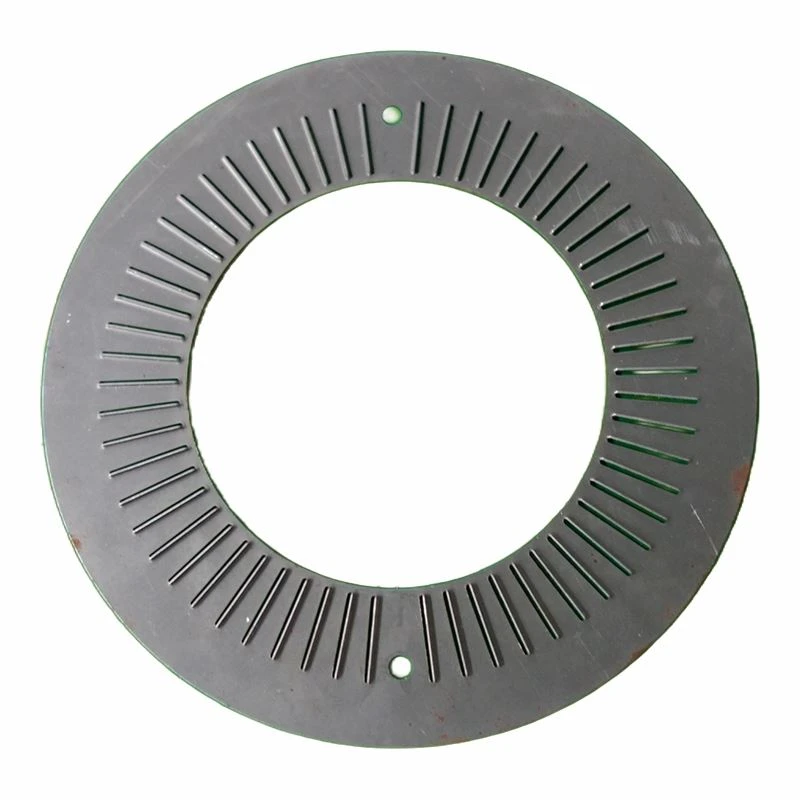
Product Parameters
|
Item |
Specification |
|
Product Name |
Stamping Part |
|
Application |
Motor Stator / Rotor Silicon Steel Lamination |
|
Part Material |
Silicon Steel Lamination |
|
Thickness |
0.35 mm |
A formed stamping part for a motor normally carries a repeated slot pattern, an inner or outer diameter, and one or more locating features. The die should keep these features concentric and control rotation from stroke to stroke. An industrial stamping part may also include interlocks, weld notches, skew references, or ventilation openings; these should be evaluated on a sample stack rather than on a single loose lamination. The drawing needs a clear burr direction and a realistic burr-height limit for the selected electrical-steel coating.
Whether the lamination is treated as a small stamping part or a larger motor blank, punch-to-die clearance must be matched to the actual grade and hardness. Closely supported punches reduce deflection around narrow teeth, while balanced stripping helps prevent dish or wave. A metal formed stamping part should be inspected for profile, concentricity, flatness, burr, coating damage, and stack height. Sharpening records are useful because the first sign of wear may be a gradual increase in burr rather than a visible dimensional shift.
Changdong can use CAE simulation where forming or local deformation requires it, then complete die design, machining, assembly, die clamping, tryout, and sample inspection. For a meaningful review, provide the 2D drawing, 3D drawing, die technical standards, press specification, annual output, material source, and stack or assembly requirements. If interlocking, welding, bonding, or post-stamping annealing is planned, that information should be released before the strip layout and inspection method are finalized.
Electrical-steel tools should have a defined sharpening trigger based on measured burr or output quantity. Punches around narrow slots need individual identification so replacement history is traceable. Material certificates, inspection results, and sample stacks should be linked to the production lot; this makes it easier to separate a material change from gradual die wear when stack performance changes. Spare-punch quantities should reflect the narrowest features and realistic lead time for replacements.
Hot Tags: stamping part, China stamping part manufacturers, suppliers, factory


