

Stampings Part
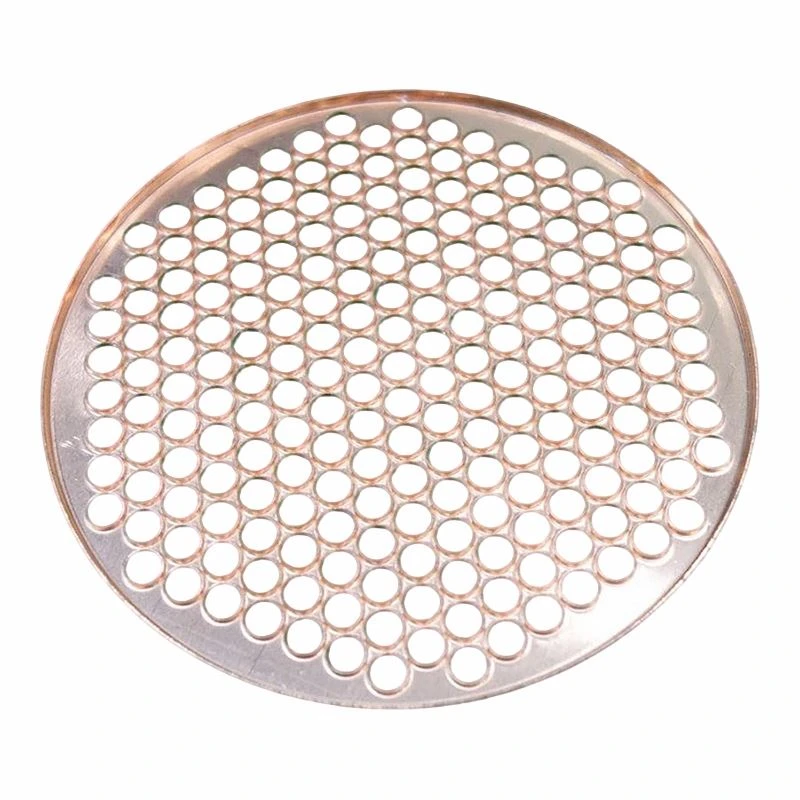
This Stampings Part is a condenser / evaporator tube fixing plate made from 1.6 mm soft copper.
The part may look straightforward because most of its visible features are holes. In production, however, the important result is not one good hole. The complete hole field has to stay in position across the plate so that the tubes can meet the pattern prepared for them.
That gives Changdong a different set of priorities from an ordinary bracket or cover. Hole pitch, the relationship between the hole field and the outer profile, local deformation around the openings and the condition of the complete copper plate all have to be read together.
Product Parameters
|
Item |
Specification |
|
Product Name |
Stampings Part |
|
Application |
Condenser / Evaporator Tube Fixing Plate |
|
Part Material |
Soft Copper |
|
Thickness |
1.6 mm |
|
Project Focus |
Tube-Hole Pattern / Pitch / Outer Profile / Flatness / Surface Condition |
|
Changdong Scope |
Tooling Development / Trial Stamping / Sample Inspection / Part Production |
A Single Hole Can Be Right While the Plate Is Wrong
This is one of the first things we look at on a tube fixing plate.
Measuring several hole diameters can confirm that the piercing size is correct. It does not tell us whether the full pattern has stayed where it belongs.
If a plate contains a long row of tube holes, a small positional difference repeated across the pattern can become much easier to see at the far end. A tube may enter the first few holes without difficulty and begin meeting resistance farther along the plate.
For that reason, the datum system on the customer drawing matters. Changdong looks at how the hole pattern is positioned from the specified reference, not simply at the distance between two neighboring openings.
The outside profile matters as well. If the fixing plate later sits in a condenser or evaporator frame, the tube pattern and the plate outline cannot behave like two unrelated parts of the drawing.
One may locate the plate in the equipment while the other locates the tubes.
A sample can therefore have acceptable individual holes and still need correction if the complete pattern is displaced relative to the mounting geometry.
What We Look At Across the Hole Field
|
Area |
Why It Matters on the Finished Plate |
|
Tube Hole Diameter |
Controls the opening available for the customer-defined tube fit or downstream assembly. |
|
Hole Pitch |
Keeps neighboring tubes in the required pattern instead of checking every opening as an isolated feature. |
|
Full Hole Pattern |
Shows whether positional variation is accumulating across the complete plate. |
|
Hole Edge |
Burr or local deformation can reduce usable clearance even when the nominal hole diameter is correct. |
|
Outer Profile |
Connects the tube pattern to the way the fixing plate itself is located in the assembly. |
|
Plate Condition |
Dish, twist or local lifting can change how several tube holes line up at the same time. |
We do not automatically apply the same tolerance to every one of these items. The released customer drawing remains the acceptance basis.
Soft Copper Can Move Around the Hole Before the Hole Size Looks Wrong
The material reference here is 1.6 mm soft copper.
Soft copper is easy to mark and easier to displace locally than many of the structural steels we process. Around a pierced opening, the material can show a small raised or dished condition even while the measured diameter is still close to nominal.
On one isolated hole, that local condition may not look serious. Across a dense hole field, repeated local deformation can influence the overall plate condition.
During tool fitting we therefore watch the copper around the opening as well as the opening itself.
Stripper condition, support and the way the material leaves the punch all show up on the sample. If copper begins sticking or lifting repeatedly in one area, the toolmaker has a physical location to investigate.
The soft surface also makes unnecessary handling marks easy to see. We do not try to make every concealed area cosmetic, but surfaces controlled by the drawing or involved in later joining should remain in the required condition.
A Stampings Part like this can spend very little time inside the press compared with the time it later spends in the heat-exchanger assembly. We judge the stamped condition with that later use in mind.
The Real Check Comes When the Tubes Meet the Plate
A dimensional report tells us what the stamped plate measures. A tube-fit check can tell us something different.
If the customer can provide the mating tube specification, fixture information or an assembly sample, it gives the project another useful reference during development.
We do not replace drawing inspection with a fit check. A tube that can be forced through a hole is not proof that the hole pattern is correct.
Instead, the assembly condition helps expose relationships that are difficult to understand from one isolated dimension.
For example, the first tube may enter easily while a later position begins pushing the plate sideways. Several tubes may fit individually but become difficult when installed together. A local raised area around one opening can also affect the way the plate sits during the next assembly operation.
Where the customer's process includes tube expansion, brazing or another joining method, the relevant requirements should be supplied with the project. Changdong does not assume that every condenser or evaporator fixing plate uses the same joining route.
When downstream information is available, we can keep the stamped-part review focused on the conditions that actually reach that operation.
How This Type of Part Is Handled at Changdong
Changdong handles both stamping tooling and stamped-part projects in our Dongguan facility.
For a plate with a repeated hole pattern, the first discussion between design and toolmaking is usually very practical: where the customer datums are, how the hole field will be created, how the copper will be supported and where the finished part is most likely to show distortion.
Once the tooling reaches tryout, the sample gives the team much more information than the CAD model alone.
If one row of openings looks different from the others, the toolmaker can compare that area directly with the corresponding punches and support condition. If the plate begins showing a dish after several openings are made, the team can look at when that condition first appears rather than trying to flatten the finished part without finding the source.
Tool manufacture, fitting and press tryout are kept within the same operation at Changdong. CNC, WEDM, EDM, grinding and drilling are available for toolmaking and later corrections.
We also have presses from 45T to 800T. The appropriate press for a tube-plate project is selected from the actual tool size and required load. We do not use press tonnage as a substitute for understanding the part.
What matters during correction is that the copper sample can go back to the people who are working on the die. The team can identify whether the issue belongs to cutting, support, part release or another part of the physical process.
Soft Copper Still Has to Reach the Customer Flat and Usable
Production does not end when the fixing plate drops from the tooling.
A 1.6 mm copper plate can still be bent, scratched or rubbed during collection and packing. A hole field that leaves the press in good condition is of little value if the plates reach assembly with damaged edges or a distorted corner.
Stacking method therefore depends on the finished shape.
If direct plate-to-plate contact can rub a controlled surface, separators can be considered. If the product geometry allows plates to catch on one another, the packing orientation becomes important. Where excessive stack weight could deform the lower parts, the number of pieces per stack can also be limited.
We prefer those decisions to come from the real product rather than from one standard packing instruction used for every stamped component.
The goal is simple: the part measured at Changdong should remain in essentially the same usable condition when it reaches the customer's assembly area.
FAQ
For a New Tube Fixing Plate Project
If you are developing a condenser, evaporator or another heat-exchange assembly that uses a stamped copper tube fixing plate, send Changdong the drawing and expected production quantity.
We can review the hole pattern, copper specification, tooling requirement and downstream assembly information before the manufacturing route is finalized.
For this Stampings Part application, the target is not simply to punch a large number of holes. The finished plate has to carry the complete tube pattern into the customer's assembly in the condition defined by the drawing.
Hot Tags: stampings part, China stampings part manufacturers, suppliers, factory, aluminum stamped components, custom sheet metal components, custom stamped reinforcement parts, custom stamped shields, metal stamping contacts, steel stamped components


